Company:
Die Autobahn is responsible of the planning, construction, operation, traffic management, maintenance, financing, and asset management of Germany’s motorways and highways
Industry: Infrastructure Operator
Country: Germany
How ORIS Identified for Die Autobahn a Reduction of 8,000 Tonnes of CO₂
Most infrastructure operators waited for EU regulations to force carbon measurement. Die Autobahn didn’t. Managing 350+ construction projects annually, they knew waiting meant scrambling. And when EU regulations made carbonmeasurement mandatory, what started as a proactive initiative became a strategic advantage.
“Before our collaboration with ORIS, our goal was simply to calculate project emissions as comprehensively as possible but it soon became clear that ORIS can actually transform decision-making processes.” recalls Oliver Krenz, Head of Sustainability at Die Autobahn. “We were able to identify a potential reduction of around 8,000 tons of CO₂, all within the boundaries of the current regulatory framework.”
The challenge
Reducing carbon emissions starts with measuring them
At the beginning of the journey, Die Autobahn’s leadership asked a simple question: “How can we reduce our infrastructure projects’ carbon footprint?”
The answer required a fundamental shift: to reduce CO₂ emissions, they first needed to measure them accurately.
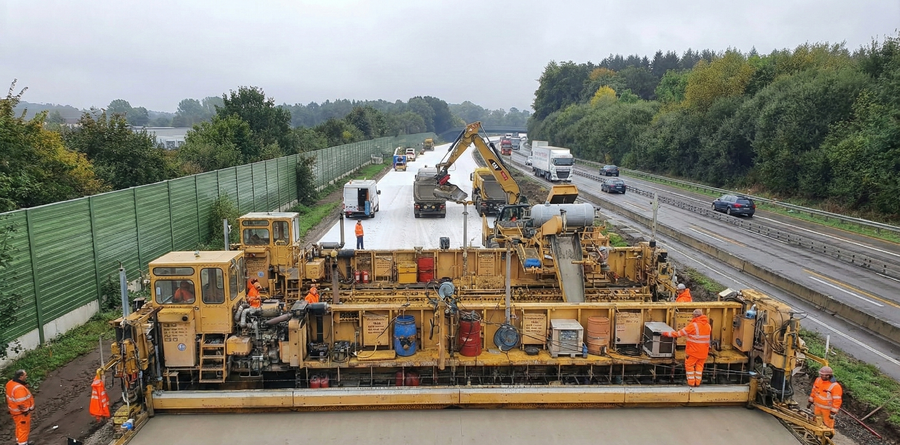
This meant that across 13 projects - covering pavement refurbishments, bridge works, and rest area reconstructions - Die Autobahn needed standardised carbon accounting that engineers could actually use during design and procurement.
When ORIS started, half of the projects were already completed, allowing us to measure emissions retrospectively and establish a baseline for future improvements. The other half was still in design, allowing our team to guide engineers toward low-carbon choices, from more innovative materials to local sourcing and optimised layer design.
Soon after they began mapping emissions, EU regulations made carbon measurement mandatory. That is when what started as a proactive initiative became a strategic step ahead.
The requirement went beyond just data To reduce emissions effectively, Die Autobahn needed more than data. It required strong expertise in sustainability and industry know-how in the infrastructure sector. ORIS’ tech-enabled services, leveraged by ORIS experts in road and pavement engineering, provided them with a complete life-cycle analysis from materials extraction to road construction (A1–A5), assessing carbon footprint, cost, and material use for all their projects in a unified, harmonised view.

The Solution
Speaking the same language with a robust and trusted methodology
Built by road engineers for road engineers, ORIS combined recognised data accuracy with real-world infrastructure insights, making it easy for Die Autobahn to trust the platform and act on its recommendations.
Unlike generalist carbon tools, ORIS brings deep infrastructure expertise grounded in European standards and a platform explicitly designed for highways, roads, and bridges.
Engineers could compare road designs and material combinations based on local climate and materials availability, then focus only on the most viable options. The platform narrowed down complex variables into clear, relevant scenarios aligned with road construction standards in Germany and Europe.
They quickly saw ORIS as a powerful additional value. It helped them save hours of work and make smarter, data-driven decisions during the tendering process.
“Before our collaboration with ORIS, our goal was simply to calculate project emissions as comprehensively as possible but it soon became clear that ORIS can actually transform decision-making processes. We were able to identify a potential reduction of around 8,000 tons of CO₂, all within the boundaries of the current regulatory framework."
.png?width=130&height=130&name=Design%20sans%20titre%20(64).png)
Oliver KRENZ
Leiter der Abteilung Nachhaltigkeit, Die Autobahn

Key capabilities during this project:
• More innovative planning: Engineers could compare road designs and material combinations based on local climate and materials availability, then focus only on the most viable options
• Streamlined decision-making: ORIS narrowed down complex variables into clear, relevant scenarios aligned with road construction standards in Germany and Europe
• Regulation-ready: The platform integrates current regulations and is built to anticipate upcoming EU carbon reporting requirements
• Engineer-to-engineer dialogue: ORIS speaks the same technical language as the teams on the ground, making collaboration smooth, fast, and effective
• Cultural alignment: With an international team including German-speaking experts, communication remained professional, smooth, agile, and tailored to local needs
The client outcomes
Delivering clarity, confidence, and measurable results
This allowed Die Autobahn to implement sustainability through more innovative planning, streamlined decision-making, regulatory-compliant processes, engineer-to-engineer dialogue, and cultural alignment.
The result: identifying 8,000 tonnes of CO₂ reduction.
What ORIS delivered:
ORIS showed Die Autobahn the different scenarios at an early design stage to inform decisions on carbon emissions and material consumption. The platform can either calculate past project emissions or provide the data needed to make the best decision in the planning phase.
Even though engineers have their own specialised tools for pavement engineering, they saw in ORIS a completely new software a substantial additional benefit to their stack that saves time in their tendering processes.
Reduction options were chosen in the planning phase, and ORIS helped identify and reduce by 8,000 tons of carbon emissions on the 13 projects.
Discover similar case studies