


Hello, infrastructure leaders and operators,
The gap between infrastructure professionals' knowledge and their ability to act on it continues to shrink.
At Highways UK this month, something felt different. The conversations weren't about why sustainability matters... that debate is over. They were about the 'how' to integrate carbon assessment into design and the 'when' (spoiler alert: it's better when it impacts decisions, not after they're locked in).
And that felt good: an authentic 'walk the talk' moment.
Highways UK: a market in search of practicality
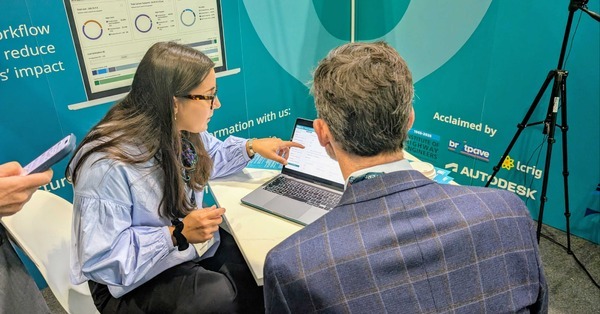
Sabrina Buquoy, Laura Traseira-Piñeiro, and Alexandre Belkowski from our team spent two days talking to people specifying and delivering infrastructure in the United Kingdom. The pattern was clear: design teams want lower embodied carbon in their projects, but carbon assessments happen too late, long after high-impact material decisions are locked in. When life cycle analysis enters the picture, you're optimising at the margins instead of fundamentally rethinking the design.
The constraint does not seem to be commitment, PAS 2080 alignment, or capability. We heard design teams run through an approval maze under ever-tighter budgets, fragmented data systems, and time pressure. They don't want another spreadsheet on top of their work, making carbon footprint calculations feel like solving a Rubik's Cube.
They need tools to be seamlessly integrated into existing workflows.
These English takeaways made this month's recognition timely: ORIS has been featured in the Life-Links Framework for Resilient Supply Chains and Logistics, launched ahead of COP30. Its not our technology that was recognised, but our methodology for infrastructure resilience assessment.
Why the Life-Links framework is important
Building resilient supply chains, with low-carbon transport infrastructure has become one of today’s most urgent challenges. And greatest opportunities. As climate impacts, geopolitical shifts, and systemic disruptions grow in frequency and intensity, it’s clear that resilience must be embedded into the each and every infrastructure that keeps our economies and communities connected.
At ORIS Materials Intelligence, we support case studies of vulnerable economic corridors, as well as unpaved rural roads whose essential purpose is to enable the transport of vital supplies to communities. But truthfully, the road between proposing and implementing is longer than a few kilometres. It demands thorough technical assessments, AI for data structuring, careful selection of adaptation measures, and, above all, a great amount of collaboration between different parties to get it done.
The same applies for supply chains with a multidisciplinary level (production, tranport, distribution..). A shared framework and common understanding have long been needed to help navigate this journey.
We are proud that ORIS has contributed as an infrastructure resilience specialist and as a member of the Life-Links Council, together with our resilience expert Danilo Ebbinghaus-Carrera, in the development of the newly launched “Life-Links Framework for Resilient Supply Chains and Logistics – A Framework for Collaborative Action.”
The Life-Links Framework offers a practical pathway to co-create resilient, low-carbon systems that deliver both climate and development co-benefits.
Following events where you can catch us
- 4/11: Autodesk Rail Summit - Madrid (Spain)
- 13/11: Webinar '4 Objectives Every Engineering Firm Needs to Scale Infrastructure Carbon Management' with Ramboll (online)
- 19/11: RWTH Aachen University Sustainable Road Institute Annual Meeting - Aachen (Germany)
- 02/12: IRF Annual Conference
Let's act now for sustainable infrastructure.