Listen on YouTube, Spotify and Apple Podcasts
Every road, rail line and port relies on the electricity system, and that system is being rebuilt at the same moment the climate it was designed for is changing. Heat pumps, electric trucks, offshore wind and data centres are all arriving on grids whose standards were written for a milder century. AECOM's energy and environmental teams work on exactly this: the major systems infrastructure behind the energy transition, from generation to the connections that tie it to everything else.
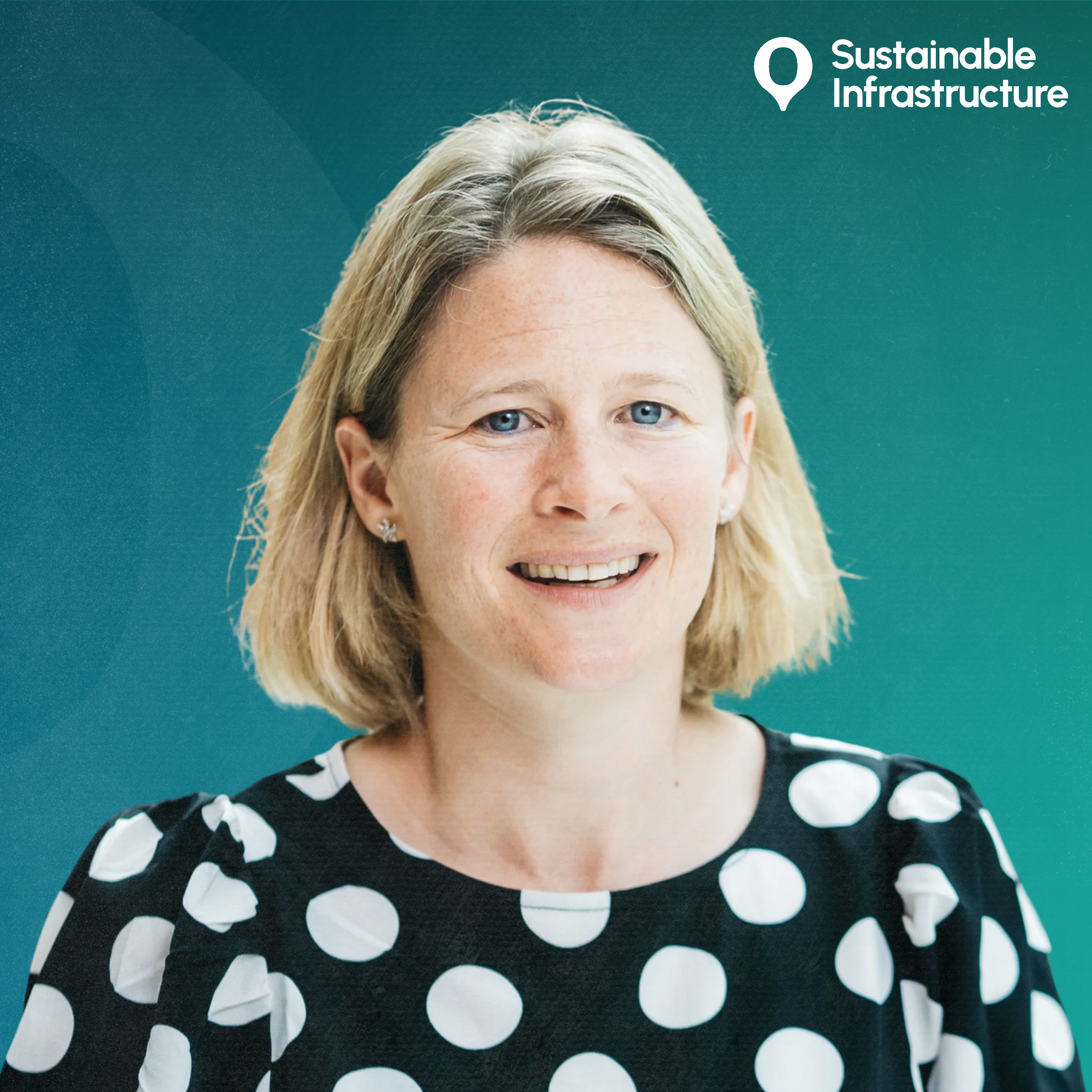
Helena Rivers leads strategy and growth for that work across Europe and India. She is a chartered mechanical engineer who began her career in nuclear energy and has spent the last sixteen years helping clients take their estate to net zero. Her angle is the energy system as a whole rather than the individual asset, which is why she keeps coming back to the same point: the decisions that shape the grid are still taken in separate rooms.
In this episode, Helena and Nicolas Miravalls, co-founder and CEO of ORIS, cover why adaptation and mitigation cannot be separated, why smart controls beat behaviour change, how electric vehicles and microgrids reshape network capacity, and where data centres, small modular reactors and fusion fit. Ending on a practical takeaway: cost major environmental events into your risk assessments, and the adaptation measures follow.
Why adaptation depends on how far mitigation goes
The adaptation debate often sounds like a choice between two budgets. Helena rejects the framing. Climate change is already here, she says, and Europe felt it in 2026 in a way it once associated with other parts of the world. On a cost-benefit basis, there is no option to skip adaptation. But how much adaptation we need depends on how much we mitigate.
That is the business case for mitigation, and it becomes clearer when you look at the bills after floods, fires, and droughts. Design standards across the region have not been updated as fast as the climate has moved. What used to be a one-in-100-year event may now be a one-in-10, or in some places annual. The unknowns worry her more than the visible changes: wind turbines blown over in storms, subsidence in places that never had it.
The consequence for design: do it once, but well. A major upgrade done for mitigation has to carry the resilience for the future climate, particularly for high-voltage assets exposed to flooding. Every project still has a budget, so the live question is where to compromise. Build in complete flexibility, or choose specific paths and spend the savings on resilience?
"What used to be a one in 100 years event may now be a one in 10 years event, or potentially some of them every year."
Why flexibility is a systems problem, not a behaviour problem
Two years ago, the flexibility conversation was about storage and base-load power. As renewables keep getting cheaper, the focus has shifted to matching supply and demand hour by hour and season by season, and the answer differs by country. Spain peaks with solar at midday. Scotland, with its offshore wind, often peaks overnight. Interconnectors help, because demand peaks fall at different times across time zones.
Helena's sharper point is about demand. We should ask when we genuinely need the power and when it is habit. Demand-side controls already work: some energy companies install them, and customers do not notice. Time-of-use tariffs also help, but they ask individuals to change behaviour for the benefit of the system, which she calls phenomenally hard. Peaks are short and predictable, the kettles at half-time in a big football match being her example. Switch heat pumps off for five minutes, and nobody feels it.
So she backs the engineering route. Commercial buildings already have control systems that need only re-tuning, while homes have no connection between a fridge-freezer and the heating controls. That is a significant system change, but it is easier than behaviour change, and the smart-meter rollout shows the public can accept it.
"It is much easier to drive that system change and get it implemented than it will be to drive it through the behavior change."
No energy transition without transmission
Electric vehicles are both a threat to the network and part of the fix. Helena has a small battery in her loft and a much larger one in the car outside, and vehicle-to-grid use of that second battery could flatten peaks if owners are rewarded for it. For trucks, the strain is real: charging sites are going up beside former major energy users because that is where the high-capacity grid connections already exist. The grid connection, not the logistics case, decides where the hub goes.
The remedy is local. Charging sites with their own generation and storage, and ports where offshore wind comes ashore next to heavy industrial demand, cut the connection size and the transmission losses. Waste heat from data centres or factories, pushed into heat networks, does the same for the biggest energy demand in northern Europe.
Underneath is an organisational problem. Decisions on transport, buildings and water are made separately from energy decisions, and that made sense historically. It no longer does, because electrification is turning assets into multi-use energy assets. Nobody says integration is easy, and valuing the benefits of different scenarios is hard, but it is where the work has to go.
"I'm sure listeners will have heard before the phrase there is no energy transition without transmission, but it is absolutely true."
Securing power: data centres, SMRs and fusion
Data centres are the largest unknown in every demand model. Growth has not matched expectations, largely because the facilities have become far more efficient, yet they are power-hungry and cannot flex: they must ramp up whenever they need to. Developers are therefore looking at every energy source. In the US, gas turbines are being installed, but large turbines have about a five-year lead time, so in Europe a grid connection often arrives sooner than a turbine.
Because data centres are now treated as nationally critical infrastructure, they get priority in the connection queue. Helena sees a better use of the system in co-location: put hyperscale facilities where excess generation already sits, such as Scotland, rather than send that power to the south-east of England.
On nuclear, she sees small modular reactors (SMRs) as an important part of the mix but expects nuclear to stay at about 10% of it, because renewables are so much cheaper. Fusion is the long bet: a limitless clean energy source if it can be mastered, nowhere near a short-term solution. And a myth to retire: SMRs are not small.
"One myth I would like to bust though is we call them 'small modular reactors'. They are not small."
Her advice to anyone starting tomorrow
Update your risk assessments. Put major environmental events into them with a cost attached, and adaptation measures start appearing in your design solutions without anyone having to argue for them. Helena is a positive person and believes mitigation is already built into designs. The shift is to look across the full life of the asset, where designing for resilience and adaptation plainly pays.
For the one change she would make in the next twelve months, she is unglamorous about it: interoperability of digital controls. Demand-side control only works if each appliance can talk to a standardised control centre, and that will take regulation on how assets output their data in a standard form.
Full interview
The following is an edited transcript of the conversation.
Adaptation and mitigation
Nicolas: Hello, you're listening to Sustainable Infrastructure, the ORIS podcast, where engineers, policymakers and construction leaders share their experience on how the world can build infrastructure fit for the environmental and social challenges of the twenty-first century. I'm Nicolas Miravalls, co-founder and CEO of ORIS Materials Intelligence. Our guest today is Helena Rivers, strategy and growth director for energy and environmental across Europe and India at AECOM. Helena is a chartered mechanical engineer who started her career in nuclear energy and has spent the last sixteen years helping clients take their estate to net zero. Today we are going to learn a lot about energy and its relation to infrastructure. It's a major theme when talking about any infrastructure emission. We'll explore with Helena her views on how to decarbonise, how to distribute, how to transport, and how adaptation and decarbonisation have to be taken together. I'm very happy to have you, Helena. Welcome to our podcast. Tell us a little more about you first, and about your role at AECOM.
Helena: Thank you, I'm really happy to be here, and thank you for the great introduction. In my role in strategy and growth, in energy and environment across the region, my focus is on the major trends in energy transition and how we can support organisations in accelerating delivery, to support their journey to decarbonise, but through the energy-upfront lens, as opposed to focusing so much on the asset-level solution. That's typically around major systems infrastructure.
Nicolas: Excellent. I mentioned that energy is a big part of any infrastructure. On the mitigation side, we spend a lot of time calculating and measuring carbon emissions on any activity, but it all goes back to energy in the end. At a time when we speak a lot about adaptation and resilience, what's your view on mitigation, and energy mitigation at large?
Helena: If you look at any cost-benefit analysis, we have no choice but to undertake the adaptation, because climate change is happening and it's happening right now. 2026 has been a year where we felt it all across Europe, so it has brought it closer to home for us. It used to be a challenge for other nations in other parts of the world, and now it is very much a real and live challenge for us right here. But how far we have to go with the adaptation is entirely dependent on how far we go with the mitigation. We have a huge responsibility to protect the planet for future generations, to mitigate as far and as fast as we can, but it also makes very good business sense. If you look at the rebuilds after major weather events, whether that's flooding, fires or droughts, you very quickly find that the business case for mitigation is the better place to be investing. The much more challenging question is how you make that equitable. It's a global challenge.
Nicolas: Very interesting. On the assets themselves, the substations, the grid, the cables and every piece of infrastructure around that, are we also designing for 2060, 2100, with very clear adaptation plans?
Helena: It's very hard, because nobody can agree on quite what our climate is going to be in 2060. A lot of our design standards across the whole region haven't been updated recently, even though we recognise there is going to be greater climate change than we previously modelled and anticipated. Different countries are taking slightly different approaches to incorporating adaptation, but there is full recognition that we can't afford to do it twice. If we are undertaking a major upgrade for mitigation, we absolutely need to incorporate the resilience and adaptation for that future climate, and a lot of measures are being incorporated to enable that. But it's always back to the cost-benefit analysis. What used to be a one in 100 years event may now be a one in 10 years event, or potentially some of them every year. We can see the change that has happened. But with the major weather patterns that really affect our climate, like El Niño, we still don't know how that's going to change things. So we are adapting for the changes that we can see, and I'm still very concerned about the changes that we can't see. As we see onshore wind turbines blown over in major storms, and areas which have never experienced subsidence experience it now because of the levels of drought, it makes you realise all of the elements that are going to need to change within our infrastructure systems.
Nicolas: Absolutely. Does this trigger new designs or new ways of designing, or is it more about being conservative in our assumptions?
Helena: Different assets have quite different solutions. We're making changes around exposure to floods, and in delivering the energy transition we're often working with high-voltage power assets, which are particularly susceptible there. It's also about how we deliver those solutions: designing so that they are inherently resilient, and designing to manage both the unknowns around our future energy pathways and the unknowns around resilience. But there is no project anywhere in our region without budget constraints, and there have to be compromises at asset level and network level. One of the areas where we're seeing a lot more conversation is: what is the right area to compromise on? Do we build in complete flexibility, or do we select specific paths, restrict ourselves in certain areas and use some of that budget for more resilience? That is the trajectory we are currently on.
Flexibility and demand
Nicolas: I'd like to hear you now on systems thinking: the generation, the network and its flexibility. We probably have enough generation of power, but maybe at the wrong time. How do you see this flexibility demand, which is increasing these days, and what's the answer?
Helena: Again, a really good question. As recently as two years ago the conversation was around two areas: storage, and base-load power solutions so that we didn't have to worry so much. As renewables have become cheaper and cheaper, and continue to do so, there is a recognition that we need more robust ways of matching supply and demand variations. That breaks down into hour-by-hour variations and season-by-season variations, and it's important to acknowledge that the challenges differ by country depending on the base-load generation. In Spain, where we have huge amounts of solar already deployed, we get the peak generation in the day. In Scotland, where we have huge amounts of offshore wind deployed, we often get our peak generation overnight, with the maximum winds. Interconnectors are part of that, from both a supply and a demand perspective, because where there is a time difference the demand peaks happen at different times, and that's really helpful.
But fundamentally, from a systems perspective, we need to think about when we genuinely need the power we are demanding, and when it is just a habit that we have power at those times. I'm thinking particularly about demand-side controls, whether in residential buildings, in our own homes, or in commercial buildings. We are not accustomed to having demand-side controls in place. Some innovative energy companies are starting to install them for some customers, and the consumers don't even notice the changes. We're doing this partly through smart controls installed by the energy companies, and partly through incentivising with time-of-use tariffs. The incentivisation is a very slow process, because the individuals making the energy-use choices have to understand how the energy system works and change their behaviours, not necessarily to benefit themselves but to benefit the broader system. That is phenomenally hard to achieve.
So bringing smart controls into all sorts of assets has a huge opportunity to alleviate pressure on our national power systems. Often those peaks in power demand are in really short periods. We have a very English stereotype: if there's a big football game going on, at half-time everybody goes and turns the kettle on to make a cup of tea. Those peaks are very predictable. If you turn people's heat pumps off for the five minutes of that peak, nobody's going to notice any change in temperature. If you ramp down people's ventilation systems, again, nobody's going to notice. There are huge amounts of power drawers that don't need to be on constantly. The massive challenge is the connectivity between the assets drawing that power, which don't need an uninterruptible supply, and the controls. Big commercial buildings already have smart control systems incorporated. They may not be optimised for this purpose, but that is a relatively easy transition. In residential buildings there is no connectivity between my fridge-freezer and my heating and ventilation controls, so there is quite a significant system change required.
From my perspective, it is much easier to drive that system change and get it implemented than it will be to drive it through behaviour change. The balancing of grids is complex, and getting everybody to choose to understand it is a big journey. Whereas getting people to understand the benefits of smart controls, in the same way as we rolled out smart meters to huge parts of the population across Europe, I think is much more achievable.
Transport, microgrids and the energy system
Nicolas: To complete this with the transport system: when we talk about energy, we talk a lot about housing and personal use. But at an industrial scale, what's the impact of the electrification of vehicles, the e-buses, the electric cars, and even trucks now going electric? How does that affect networks and capacity? We often hear that motorways and highways will eventually suffer from low capacity in distributing the energy. Do you see that as a threat to distribution and the whole energy system?
Helena: I think they're both a threat and potentially a solution. Listeners have probably heard about vehicle-to-grid solutions. I sit here with a small battery in my loft, attached to my solar panels, but a much larger battery in the car that sits outside my house. If we could find smart ways to use that battery to manage the peaks and troughs, that would be phenomenally helpful. There is a lot to be said for local solutions and local networks, so that we save some of the transmission and distribution losses. The more we can use batteries for multiple functions, the more efficient our systems will be. Going back to the commercialisation of that: the most expensive element of my electric vehicle is the battery, so I want to look after its life, and we all know from our mobile phones the importance of how we charge. So we need to be incentivised in an appropriate way to use our vehicles' batteries like that. In terms of reducing system costs, it's very significant. It's about how we reward people for making that choice.
If we look at larger vehicles, and you mentioned trucks in particular, there are a few emerging solutions. There is a model, starting to be rolled out, where truck companies have their own batteries rather than the individual truck having one, so rather than waiting while the truck's battery recharges, they swap it. That's quicker, it reduces downtime for the driver and brings efficiencies. It also means the recharging doesn't need to be as high-power, because there is a longer period before the next truck needs it. That is a very nascent solution. The much more common one is that while truck drivers are taking their mandatory breaks, the batteries are being recharged. Does that create a significant strain? Yes, it absolutely does, and we're starting to see these recharging sites built where there are old major energy-user assets and therefore high-capacity grid connections. It's that connection to the grid that dictates the right place for these logistics hubs.
Our grids are changing throughout all European countries. Listeners will have heard the phrase "there is no energy transition without transmission", and it is absolutely true. As we remodel our energy systems to capitalise on all of the generation, rather than relying on a smaller number of mega generators, we also need to reshape how we distribute that energy back out. Do I think there are strains? Yes, there are already strains. But as we upgrade our transmission networks across Europe, albeit at different phases, this is being incorporated in that solution.
Nicolas: So if I understand you well, it's about distributing the load over more batteries, more assets and microgrids.
Helena: Microgrids have a massive part to play. Wherever we put in these new charging facilities, they typically have an associated generation facility, potentially additional battery storage, depending on the model. The more we can reduce the transmission requirement for the energy we're generating, the stronger the financial sense, and from an energy systems perspective it saves all of those losses. We can see it on that micro scale, but you can also see it at a much larger scale. Ports are a prime example: there's huge industrial usage, and most offshore wind comes into port, so there is often an opportunity to capture that generated power and distribute it within the local network. The benefit to the grid from the reduced connection size is significant, and so is the benefit to the energy system of not having all of those losses.
Nicolas: Traditionally, the energy network and the transport network were in different places and used different things. Do you see road assets, railway corridors or the transport system being used for energy transportation, closer to where the energy is used?
Helena: As infrastructure corridors, probably less. As a catalyst for the transition, very much so. One of the recurring themes is the disconnect between different elements of what I'm going to call the energy system. Transport decision makers, building development decision makers and water infrastructure decision makers are making decisions completely separately from energy decisions. Historically that made sense. But as we become a much more integrated system, with electrification driving the changes and a lot of our assets becoming multi-use assets that incorporate energy use, we're seeing a need for integrated decision making in a way we've never really had previously. Nobody is suggesting that's easy, and it's really difficult to evaluate the different benefits of different scenarios, but one is definitely starting to influence the other much more, and that trend will continue.
Something that's really interesting from a new town development perspective: fundamentally we want to minimise the future occupants' energy costs, so we need to think smart and stop wasting all forms of energy. Let's start with heat, because we waste heat all over the place, and in northern Europe heat is probably our highest energy demand. Capturing waste heat, whether from a data centre or a manufacturing facility, and putting it through heat networks is one of the important ways in which we get that system thinking together. Equally, how much can we generate locally, and how much can we distribute on the microgrid, to minimise our impact on the national infrastructure system and also the local energy costs, recognising that in a cost-of-living crisis, energy is something no one can live without.
Data centres, SMRs and fusion
Nicolas: And we have to be very cautious with how we use it. You mentioned data centres, and there is no good talk today without AI. Not AI per se, but the energy demand it newly requires. This is a massive new demand, and it can change the production and consumption balance. Data centres are the new infrastructure coming up all across Europe. How do you see them developing, how do they affect energy production and consumption, and how will that affect other usages that might suffer? There is maybe a new equilibrium to find here.
Helena: It's really hard. When NESO and other organisations model future energy demand, there is always a huge unknown around data centres. The rate of growth of power demand from data centres has not in any way matched the expectation, in large part because data centres themselves have become much more energy efficient than they were five years ago, and they continue to improve. That said, they are very power-hungry and they absolutely demand reliability. To our earlier conversation about system integration and matching demand with supply, data centres cannot support that, because they need to be able to ramp up whenever they need to. That is one of their critical demands.
What are the right energy solutions? As you would expect, there are lots. Renewables still play a part, because data centres will consistently have a power demand, so whenever you can generate locally, the data centre can use that capacity. Depending on the scale, there is also a very ambitious solution: in the US we see a lot of gas turbines being installed to support continuous supply. One of the problems with gas turbines is the supply of them. There is massive demand right now, and for significant-scale gas turbines there's probably about a five-year lead time. For most data centres you can actually get a grid connection faster than you can get a gas turbine, so across Europe we're not seeing quite the same uptake of gas. Longer in terms of development, but increasing in terms of discussion, is the use of SMRs, small modular reactors, to provide a very secure, very resilient energy solution. A lot of the hyperscale developers are looking to locate adjacent to nuclear-licensed sites. Obviously that's very limited, so it's not going to be the answer for all data centres. But the key point is that data centre developers are in such need of power that they are looking at all energy vectors to secure it, from nuclear to new renewables.
Nicolas: Don't we have a time disconnect between the immediate need of a data centre, which can be built in one or two years, and the energy solutions you mentioned, which take five or ten years? I understand that in the long term it matches very well, but how will we manage the period in between?
Helena: Data centres have become nationally critical infrastructure, and as a result they get priority in the grid connection queue. Largely, at the moment, we are enabling connection through national grid systems, while still minimising the requirement for that grid with local generation and storage. That means more data centres are able to connect, but there are still going to be limits. One of the interesting national-level conundrums is how to get data centres to co-locate where we have excess generation. In Scotland we get a lot of excess generation from offshore wind, and rather than transmitting all of that excess power down to the south-east of England, it makes much more sense from an energy systems perspective to put hyperscale data centres up in Scotland, where they can access that excess power.
Nicolas: Very interesting. You mentioned SMRs, and AECOM and yourself as an energy specialist are very much involved in them. Do you see SMRs as a solution, or the solution, for the future? Could you grade the different solutions against the needs?
Helena: I very much see SMRs as an important solution in the future energy mix. I don't think nuclear is going to be more than about 10% of our future mix, because renewable energy is so much cheaper than nuclear is likely to get, even when we deliver it at a major programmatic scale, as France has demonstrated with great success. What that nuclear mix is going to be is another really interesting question. There is a lot of innovation, and for me a lot of excitement, around the potential of fusion. The UK government has invested £2 billion in developing STEP, a new fusion test reactor to be based in Nottinghamshire. It's not just the reactor, but the massive magnetic solutions needed around it. There is huge investment in Italy, China is adopting AI to try to model how we get fusion from the short-term generation we can currently create to long-term stable generation, and there are lots of developments in the US. There are government-funded solutions, but there's also significant private investment going into fusion for the first time since the Second World War. It's an area you have to put hope and belief into. It's definitely not a short-term solution, and we talked about the slow development of an SMR; this is a much longer-term potential solution, but one that changes the whole energy system. If we can conquer fusion, we essentially have limitless clean energy, and that will change the way we operate in every element of the way we choose to live, and certainly deliver all of the mitigation we need. As I say, it's a long way off. We still have big fission reactor fleets that will continue to operate across Europe for the foreseeable future, and many countries are starting the permitting process for their initial SMRs, which will be the first new generation for some time.
One myth I would like to bust, though: we call them "small modular reactors". They are not small. People imagine a shipping container you can just pop down. Actually we need space on the scale of several football pitches. It's not going to be everyone having one in their back garden, although there are now various developments around much smaller-scale reactors, so who knows? Let's see where that technology might take us.
Nicolas: We could keep the acronym with "smaller modular reactors".
Helena: Exactly.
Rapid-fire questions and advice
Nicolas: That's a very positive note on fusion, even though long term. That's where the energy is heading, and having this decarbonised, limitless capacity in the future is really exciting. Thank you for sharing this perspective in difficult times. It's a good time for closing, and we have a tradition here of closing with what we call rapid-fire questions. If you had one change to propose in the next twelve months for the energy system, to speed up decarbonisation and flexibility, what would it be? What's the one magic thing you could do?
Helena: It isn't a very sexy answer, but it would be interoperability of all of our digital controls. Demand-side control is the area where we can make a huge difference, and that can only happen if the controls of each individual appliance can talk to a standardised control centre. I think that will only happen through regulation: regulation around how those assets output their data in a standardised form.
Nicolas: Amazing. Let's hope for that. My last question: for an asset owner or an engineering consultancy firm, which is probably most of our listeners today, what is the first concrete step you would advise toward designing for adaptation and decarbonisation together?
Helena: The first step to make it a reality is to update the way we do our risk assessments, to look at major environmental events and cost them into the risk assessment. As soon as we cost them in, we will be incorporating a lot more adaptation measures into our design solutions. I'm a positive person, and I like to think everybody is already designing in the mitigation; that is certainly the trajectory we're all travelling on. But it's the realisation that if we look over the life cycle of the asset, it makes sense to design for resilience and adaptation.
Nicolas: Thank you, Helena. The final word for today: I'm very happy we had this conversation. I learned a lot about energy today, and thank you for your views. I wish you all the success in your various enterprises. Let's meet soon. Thank you.
Helena: Fantastic. Thank you very much. I've enjoyed it too.
Guest bio
Helena Rivers is strategy and growth director for energy and environmental across Europe and India at AECOM, where she tracks the major trends in the energy transition and helps organisations accelerate delivery of their decarbonisation journeys through an energy-first lens.
A chartered mechanical engineer, she started her career in nuclear energy and has spent the last sixteen years helping clients take their estate to net zero. Her focus is major systems infrastructure rather than the single asset.
About AECOM
AECOM's energy and environmental business works on the major systems infrastructure behind the energy transition. AECOM is a global infrastructure consulting firm that delivers professional services across the project lifecycle, from advisory, planning, design, and engineering to program and construction management.