

Listen on YouTube, Spotify and Apple Podcasts
Buro Happold designs some of the world's most ambitious city developments. From London's dense, centuries-old core to blank-canvas megaprojects in Saudi Arabia, its infrastructure teams sit at the point where climate resilience, mobility and carbon targets stop being separate conversations and become one design brief.
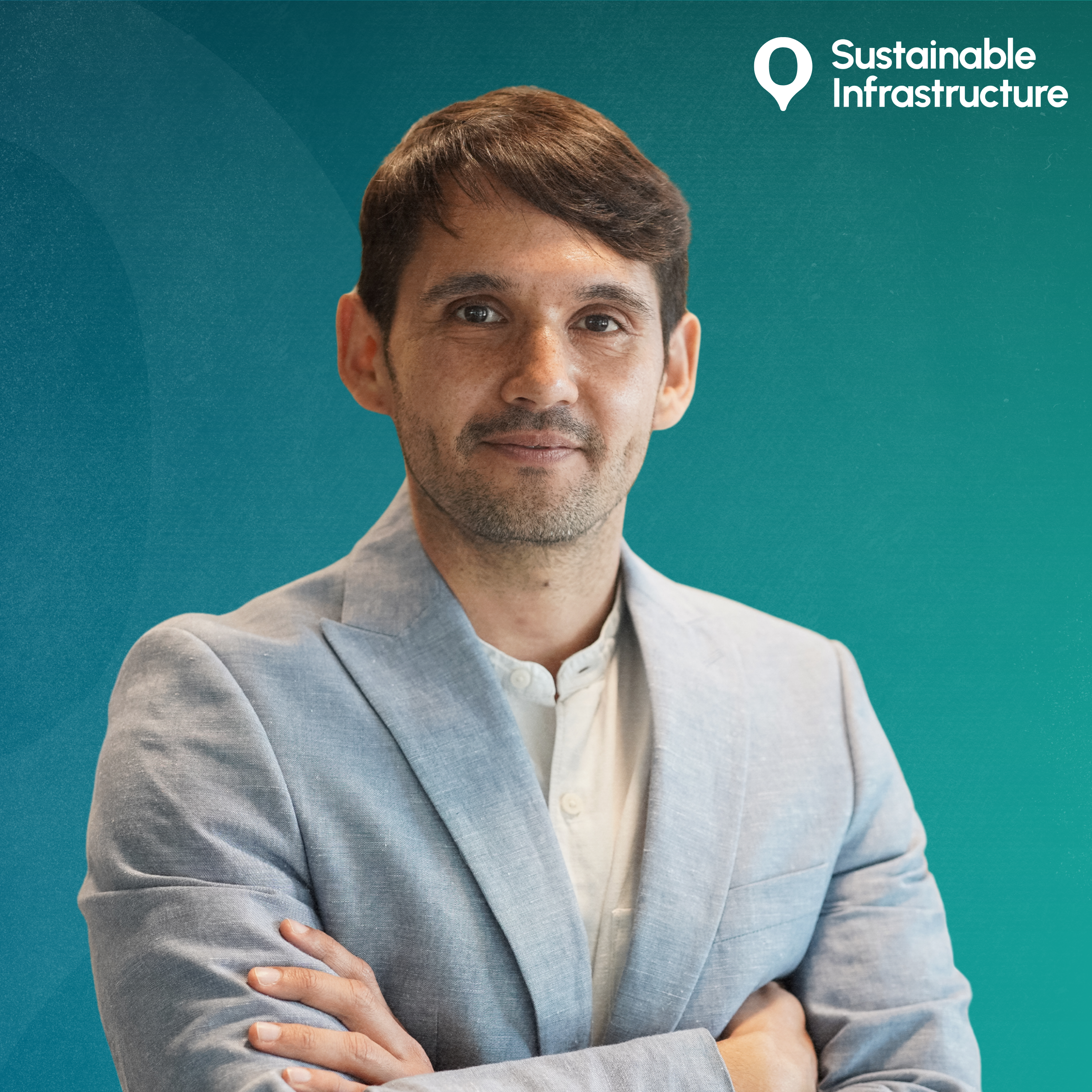
Rainier Valcarcel has spent twenty years in that brief. He started his career in South Africa, moved to the UK eighteen years ago, and now leads Cities Infrastructure at Buro Happold, working across projects from Kingston's Mini Holland cycle scheme to Riyadh Expo 2030 and Qiddiya. What changes between those projects, he argues, isn't the ambition, but the inherent constraints.
In this episode, Rainier explains why retrofitting a historic city and designing a greenfield one call for opposite instincts, why reducing carbon on a project is usually the same exercise as reducing its cost, and why the wadis of Saudi Arabia and the drains of London are solving the same problem.
The biggest lever for sustainable infrastructure for him? Bringing contractors and communities into the design room early enough that they actually own the outcome.
Retrofit London, reimagine Riyadh
Rainier's clearest framing for the difference between his UK and Middle East projects is a childhood one. Designing in London, he says, is like building with a limited set of Lego blocks: a few rectangles, a few squares, mostly brownfield sites. Designing in Riyadh is like opening a brand-new Star Wars set: every piece imaginable, and a client with the technology and appetite to use it.
Neither is easier. London's constraint forces engineers to retrofit sustainability into infrastructure that was never designed for it. This means reworking rivers, topography and existing rights-of-way into features rather than obstacles. Projects like Qiddiya and Riyadh Expo 2030 carry the opposite risk: with no constraint to react against, sustainability has to be embedded deliberately from the first sketch, or it doesn't happen at all.
"Every constraint has the opportunity to be a really interesting feature."
Saudi Arabia's Vision 2030 is doing for greenfield design what regulation does for retrofit work: giving engineers a mandate to build differently rather than defaulting to what's already been proven.
The real estate you get back when people stop driving
Most cities inherited a road network built for one assumption: everyone drives. Rainier's argument is that shifting people out of private cars doesn't just cut emissions — it frees up physical space that can be redesigned entirely. The High Line in New York, a Buro Happold project, turned disused elevated rail infrastructure into a linear park that both connects people and lifts them out of the car-dominated street level below.
The same logic is driving city-scale mobility bets in Qiddiya and Riyadh Expo, where the goal is to shift culture away from private cars before the habit sets in, using walkability and micro-mobility as the default rather than the alternative. It's a harder sell in a petro-economy city that regularly hits above 40°C, which is why Rainier frames it as giving people a genuine choice rather than mandating a lifestyle.
"It's not just about how the cities come out of the ground and how we use the actual materials to build them, but it's how people use those cities, and giving people the opportunity to make decisions around how they can do things more sustainably."
Designing with the wadi: rainfall management
London's rainfall pattern has changed during Rainier's career. What used to be rain spread evenly across a UK winter is now concentrated into single extreme events — he cites days where 25–30% of a year's rainfall lands at once. The London Plan has responded by pushing sustainable drainage into every new development, residential or commercial, so that surface water is held back rather than overwhelming pipe networks built for a different climate.
Saudi Arabia's version of the same problem runs through wadis: dry riverbeds that, once every century or several, take on 1-in-200 or 1-in-500-year storm events. On Qiddiya, NEOM and Riyadh Expo, Buro Happold's approach is to protect and enhance these natural systems rather than pipe around them: buffer zones for flooding, levels set to safeguard the built environment nearby, and hydrology models built for future demand rather than historical averages.
"It's about expanding cities... but it's about respecting those key features that are actually providing resilience and protecting people."
Carbon reduction is a cost story before it's a compliance one
Buro Happold has committed to cutting carbon on its projects by 50% by 2030, and Rainier's read on why clients buy into that target has less to do with regulation than with arithmetic. Engineers respond to metrics; it's visceral (just ask our cofounders): a clear before-and-after with a percentage attached is, in his words, an easy sell. What often gets missed is that cutting carbon on a project usually means using less concrete and less steel, which is also the cheaper option.
That overlap is why Rainier's team has started integrating carbon management toolkits, including ORIS, directly into project workflows. The goal is that this becomes a natural reflex for engineers deciding on materials and design.
"When you are reducing carbon on a project, you're actually also reducing cost... it's actually cheaper."
His advice to anyone starting tomorrow
Rainier's clearest example of getting sustainable design adopted, rather than just specified, is Kingston's Mini Holland scheme (later renamed Go Cycle): a Greater London Authority-funded project to redevelop the public realm around Kingston station, convert disused rail land into a linear park, and build a cycle and pedestrian bridge. His team brought the contractor in early, before the design was finished, and the practical feedback they got changed the scheme into something more buildable and back within budget. Two rounds of public consultation did the same job with residents, surfacing local history that ended up built into the bridge and cycle hubs.
Asked what he'd tell himself ten years into the job, Rainier doesn't reach for a technical answer. It's not about knowing more, he says, it's about the confidence to say it.
"If you have good intentions, and you have passion about something, that comes through — and I think it's a powerful thing. It doesn't matter if you're a graduate, a director, or a partner. People see that."
Full interview
The following is an edited transcript of the conversation.
Getting into sustainability
Renaud: I'd like to get to know you better, and also how you got into sustainability from a professional perspective.
Rainier Valcarcel: I've been a civil engineer now for twenty years. I started my career back in South Africa, moved to the UK about eighteen years ago, and I think most of my projects have always had that sustainability element to them, be they sustainable transport projects or ways to integrate sustainable and green infrastructure into what we do.
So I think it's always really been ingrained in what I do. At Buro Happold, we do a lot of city developments and brand new city designs, and that's one of my specialisations. Going forward, this topic around sustainability, carbon management, how we reuse and respect the environment we live in, is so important.
Retrofit London, reimagine Riyadh
Renaud: What would be your definition, your targeting, when you're approaching urban projects and this kind of large-scale reinventing of cities?
Rainier Valcarcel: It depends on the type of city. I live in London, and I'm lucky: I've got access to so many different things, be it culture, great transport systems, and a really well-established, developed city that's been built up over hundreds if not thousands of years.
From a London point of view, there's that well-developed, historical city sense to it. The opportunities are very much retrospective: how do you take what we have and bring it up to something more future-forward? On the other scale, a lot of the projects I work on are in the Middle East, and the big difference there is these are greenfield sites: big open plots where you can be more creative and try something different.
Whenever I explain this to people, I compare it to Lego. When I was a kid, I had a limited set of blocks — some rectangles, some squares. When you're in a well-developed city, and most sites are constrained brownfield sites, you have a little less to work with. But that pushes us as engineers to think outside the box, and it also allows you to bring that sustainability element in… How do you work with nature, how do you retrofit existing infrastructure to make it greener?
On the other side, a city like Riyadh, where I do a lot of work, is like being in 2026 and buying your kid the latest Lego set: a massive Star Wars Death Star or something. You've got all those pieces. Anything you can imagine for the future city, you can do, because we've got the technology and we've developed our thinking around what works from a city point of view.
Renaud: Let's start from the greenfield area. What are the main issues or factors you focus on beyond the fact of cities as a purpose in itself?
Rainier Valcarcel: All cities have their own characteristics, their own natural look and feel. The starting point should always be to look at what the constraints are, what the opportunities are; rather than just taking ideas from past projects and dropping them into a new greenfield site.
Most cities have really interesting interfaces with nature: rivers, mountains, topography. It's a case of taking that constraint and looking at it from a different point of view. Every constraint has the opportunity to be a really interesting feature. So it's about how you look at it from the start, and then really embed those key elements around sustainability and nature.
Renaud: Is there any greenfield, or near-greenfield, project where you've integrated this infrastructure and people-flow thinking?
Rainier Valcarcel: Two cities, or city extensions, come to mind. One is Qiddiya, an extension of Riyadh with the tag of being a "city of play." The other is Riyadh Expo. It's got two phases: the expo site itself in 2030, focused on the event and showcasing future technologies, and then the legacy element for Riyadh afterwards.
For both, there's a big drive to change the culture around private cars and enhance both public transport and other sustainable transport. Two things matter there: the scale of the city and how close you are to key facilities, which encourages walking or micro-mobility. In some of the hotter cities, walking and cycling isn't always logical once you're into the mid-40s and low 50s. But it's about giving people choices and opportunities to choose something as an alternative to cars. It's not just about how the cities come out of the ground and the materials we use, but how people use those cities, and giving them the opportunity to make more sustainable decisions.
The real estate you get back when people stop driving
Renaud: Regarding mobility inside cities, bringing back trams, expanding metro, moving the purpose of a street into something else. Any major projects like that you've been involved in?
Rainier Valcarcel: If you look at the infrastructure that dominates most cities, it's roads: hardscape focused on cars. Most modern cities are car-centric. It's about how you use the opportunity: if you implement key interventions that help people shift from private cars to public transport or micro-mobility, it opens up space in the right of way.
A project that comes to mind is the High Line in New York, which we worked on a good few years ago. It was disused rail infrastructure sitting at a much higher level. We took that space and created a linear park. But the key thing was that it connected people while also separating them from the ground level, which is very much car-dominated.
There are lots of opportunities to reuse infrastructure, and the key thing for us as engineers is to highlight these opportunities to clients: "You've got this amazing asset, right now you're using it to move people from A to B in vehicles. Let's plan for the future. Let's be a catalyst for change," and give people the opportunity to make a more sustainable decision.
Renaud: From an engineering perspective, are your clients pointing at this sustainability criteria directly?
Rainier Valcarcel: Definitely something starting to come through. You can see it in policies; in London, we have the London Plan, with a big push on integrating sustainability into everything we do, and a big focus on sustainable drainage for resilience.
The climate is changing. We're getting much hotter summers. It's thirty-three degrees today; I can't remember the last time it was thirty-three degrees in London. But we're also getting major storm events. What used to be seasonal rains spread across a typical winter are now annual rains. One day where you might get twenty-five, thirty per cent of your rainfall. So it's about managing that at the surface level and holding water back.
The London Plan has done a great job of integrating that — you see it across new residential and commercial developments, with a big push for resilience so that when a big storm event comes along, it's mitigated. In Saudi Arabia, the Saudi Vision 2030 has been a great catalyst for shifting how megaprojects are delivered, moving away from an oil-based economy toward something more considerate of the environment, and safeguarding water, which is a really scarce commodity there. When you see that push in policy, government, clients and developers, that's when we as designers feel free to integrate sustainability into every single design stage.
Bringing teams and clients along
Renaud: How do you engage your teams in this change?
Rainier Valcarcel: We're pretty lucky at Buro Happold. We've put real, big incentives and goals in place. We're looking to reduce carbon on our projects by 50% by 2030, and every team is developing its strategy around delivering that. We have key checklists to make sure we're considering sustainable solutions, and we work closely with ORIS to integrate carbon management toolkits.
From an infrastructure point of view, we've been trying to integrate this for the last couple of years. Our projects are really large, so when you're dealing with a city at that scale, it's challenging to do it holistically. We're now looking at it piece by piece, breaking a city into districts or campuses, and those into buildings and public ground plots. I'd like to say that by 2030 we'll have real maturity in that infrastructure carbon management space.
Renaud: What incentive can accelerate this, beyond engineering?
Rainier Valcarcel: It's about how we showcase it to clients. I'm an engineer… I love numbers. If you show me a metric, an improvement from point A to point B with a percentage next to it, I'm sold. A lot of clients are the same. What people don't always realise is that reducing carbon on a project, especially reducing materials like concrete or steel, is often also cheaper.
So it's about changing that mindset: reducing carbon and managing it through the design stages doesn't mean increasing cost. It's mutually beneficial, not just for the client and designers, but for the project as a whole.
Designing with the wadi, not against it
Renaud: Have you been involved in projects on climate resilience? How do you factor future climate conditions into your assessments, for example in Saudi Arabia?
Rainier Valcarcel: Most of the key interventions have been about looking at natural wadi systems: dry rivers found throughout Saudi Arabia and the Middle East. Even there, rainfall events are getting much larger. It's not happening more often - maybe once every five years - but they're getting 1-in-100, 1-in-200, even 1-in-500-year storm events.
On projects like Qiddiya, our NEOM portfolio and Riyadh Expo, there's a big push to safeguard these natural features and enhance them to handle future demand and hydrology from a flooding point of view. Where we build adjacent to these features, we create buffers to allow for flooding and set levels to protect people. Saudi cities are used to the heat: that's a given. What they're not used to is these massive rainfall events, so it's about creating resilience through natural features.
Renaud: For a regular UK city with a limited budget, what's the right approach?
Rainier Valcarcel: Back to my Lego analogy: if you've got limited blocks, what can you do? There's a push to help cities outside London redevelop and diversify the UK economy, so funding doesn't just go into the capital. You see key rail infrastructure coming out of the ground - Crossrail 1 and 2, high-speed rail networks - and if you create transport hubs that link cities, you get cross-city benefits.
From a funding point of view, it's about looking at a do-minimum, a do-something, and a do-everything option. Do-minimum might be installing bike parking next to a rail station to give people an incentive to cycle instead of drive. Or when upgrading drainage along a stretch of road, instead of putting more pipes in the ground, you integrate landscaping: a bioswale or a rain garden. These interventions don't have to be expensive or city-changing. Take the small wins, and when larger funding comes along, there's an opportunity to link everything up.
Renaud: Nature-based solutions seem to be getting more emphasis.
Rainier Valcarcel: We always push for it. Sometimes, with really constrained sites and wide expanses of hardscape, it's not always possible. But where we have the opportunity, we push for sustainable drainage. The benefit isn't just draining away runoff; it's resilience and how people interact with these features. A pipe or a gully below ground is purely functional: people can't interact with it. A rain garden or a bioswale encapsulates the natural environment, brings biodiversity, and changes people's perception of green infrastructure. We're lucky with our clients, because there's a really good intake.
Bringing people along
Renaud: Who has the biggest lever in the value chain to make this broadly accepted?
Rainier Valcarcel: As engineers, we're quite neutral in the process. You might have architects and landscape architects pushing for big interventions, replacing hardscape with biodiversity and new landscape. On the other side, a contractor pricing it might say that's expensive; let's put in something more traditional. Engineers sit in the middle, and we can look at it from the outside and identify the most logical and appropriate solution.
More and more, we're finding that nature-based solutions are the most appropriate. So we have that influence to present to clients and encourage them to use these solutions. That whole cost metric is something we could still work on; a greater range of solutions that fit a different range of budgets would help push sustainable drainage a lot stronger.
Renaud: Is there a way to make this happen at scale, at a municipality level?
Rainier Valcarcel: What's a strong lever is that the proof is in the pudding. Identifying a location or scheme within a borough at the right scale to test key interventions is a strong way to get buy-in.
We had a project in Kingston, South London, part of what was then the Mini Holland initiative, later renamed Go Cycle. The Greater London Authority had a scheme to fund different boroughs to incorporate sustainable transport. For Kingston, we had a forward-thinking client and a great team of landscape architects and engineers. Right from the start, we got the contractor engaged early: it wasn't a case of designing something and then handing it over to build. Some of the feedback we got was genuinely useful, practical feedback that led us to change the design slightly, to make it more buildable and bring it back into budget.
It's about right-sizing, and bringing everyone along on that journey from the start. All contractors want to do a good job and are proud of their work. It's a case of bringing them along. If you push a design onto a contractor right at the end of the design stage without keeping them engaged, you're less likely to get buy-in.
Renaud: And the citizens who live in these cities, how do you make sure they can express themselves?
Rainier Valcarcel: In London especially, there's a big drive for public consultation. It's got its positives and negatives, but that engagement is so useful. On the Kingston project, we had three key features: redeveloping the public realm in front of Kingston station, redeveloping old rail land into a linear park, and a cycle and pedestrian bridge to lift pedestrians away from the interface with vehicles.
We ran two public consultations, including a survey with multiple-choice questions and open sections for ideas. We got really good feedback that gave us a feel for the culture and history of Kingston as a town - its links to aircraft-making and to moving pictures - and we integrated some of those historical elements into the cycle hubs and the bridge. It's about engaging with people, making sure their voices are heard, and making sure the end product reflects the community.
His advice to anyone starting tomorrow
Renaud: What advice would you give to like-minded people in sustainable infrastructure to make change happen?
Rainier Valcarcel: Be brave. Cities are changing, and existing cities have to modernise. We're seeing the negative impacts of how humans have interacted with nature over the last 100, 150 years - climate change, hotter summers, wetter winters. We have the opportunity to make the change, and it starts with us. As civil engineers, we have a close link to infrastructure, to what the future of cities looks like, and to how we influence clients, contractors, and end users.
Think about what the world might look like in twenty or thirty years. Will you be able to look back and say you were part of that positive change? So: be brave. Cities change very slowly, so be patient. Twenty to thirty years in the life of a city isn't long… It's an exciting time, but keep at it.
Renaud: Is there anything you'd do differently, looking back ten or fifteen years?
Rainier Valcarcel: It comes down to experience. This is my twentieth year as a civil engineer, and ten years ago I didn't know as much as I know now: the confidence to really push those narratives to clients and collaborators wasn't there yet. What I'd tell myself is: be confident about yourself. If you have good intentions and passion about something, that comes through, and it's a powerful thing: whether you're a graduate, a director or a partner. People see that.
Guest bio
Rainier Valcarcel is Discipline Director, Cities Infrastructure at Buro Happold, where he leads infrastructure design across major city developments in the UK and the Middle East. A civil engineer for twenty years, he began his career in South Africa before moving to the UK, and now works across projects ranging from Kingston's Mini Holland cycle scheme to Qiddiya and Riyadh Expo 2030, bringing climate resilience, mobility and carbon reduction into a single design brief.
About Buro Happold
Buro Happold is a global engineering consultancy working across buildings, cities and infrastructure, with a strong track record on large-scale city development in both established urban centres and greenfield megaprojects. Its Cities Infrastructure team has set an internal target to cut carbon on its projects by 50% by 2030, and works with tools including ORIS to bring carbon management directly into infrastructure design workflows.
Resources & Links Mentioned
- Buro Happold
- The London Plan
- Saudi Vision 2030
- Qiddiya
- Riyadh Expo 2030
- NEOM
- Kingston Mini Holland / Go Cycle (Greater London Authority)
- The High Line, New York