

Listen on Youtube, Spotify and Apple Podcasts
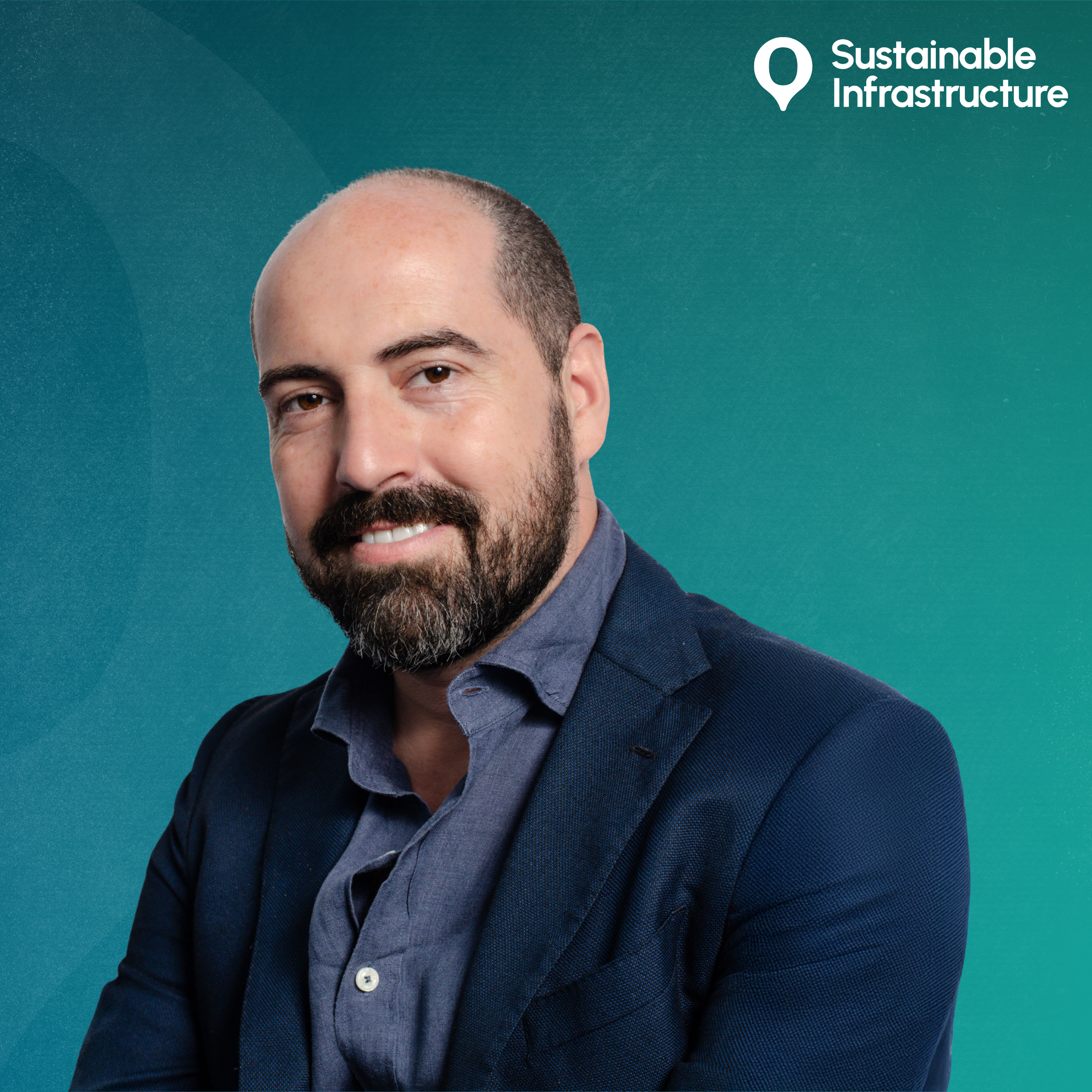
The University of Palermo's SMARTI Lab sits at an unusual intersection: the rigorous, slow-moving world of pavement materials research, and the urgent, politically fragile push to decarbonise European infrastructure. For Davide Lo Presti, Associate Professor in Engineering and founding director of that lab, bridging those two worlds has never been a side project: it is the entire point.
Lo Presti came to sustainable materials through curiosity and crumb rubber... literally. His PhD at the University of Nottingham began with a bag of rubber granules from waste tyres and a question: could this material be meaningfully integrated into asphalt? That single question, pursued across laboratories in two countries, conferences in China and Italy, and eventually the roads of Sicily, became the backbone of a career oriented around one conviction: that research which stays in the lab has already failed.
This episode covers what twenty years of pavement research actually looks like in practice: the wake-up calls, the multi-stakeholder roundtables that go nowhere, the European projects that do, and what it means to build not just better roads, but better engineers. Davide is also the driving force behind the new conference, RoadLCA, formerly the International Symposium on Pavement and Bridge Life Cycle Assessment, which comes to Palermo in October 2026. If you work in infrastructure and you are not yet in that conversation, this episode is the reason to change that.
The Wake-Up Call That Changed How He Works
Research without implementation is a comfortable dead end. Davide Lo Presti learned this at a roundtable in Nottingham, convened by the UK Tyre Recycling Association. Around the table were aggregates suppliers, binder producers, road authority representatives, and a delegation from the Ministry of Innovation. Lo Presti's side of the table had the evidence: rubberised asphalt works. The performance data was there. The literature was there.
The other side of the table had a different answer: "We have no incentive to change our culture or the things we do. We already do it as we know how to do it. Why should we pioneer something that is possibly a new risk?"
"That was a wake-up call. I realised that we can't just stay in the lab. We can't just do papers. We have to get out there and try to be an agent for change."
What followed was a deliberate reorientation of how Lo Presti approached his work. The next European project, focused on maximising reclaimed asphalt in wearing courses, was funded by the Conference of European Road Directors and explicitly included a framework for sustainability assessment alongside the technical development. The research had to reach road authorities. That was not optional.
The through line from that Nottingham table to Sicily's streets took fifteen years. Since his return to Palermo in 2019, Lo Presti has helped implement the first kilometres of rubberised asphalt in Sicily. Three or four cities now have roads paved with the technology he began studying as a PhD student. In January 2025, Italy introduced minimum environmental criteria for road procurement, mandating reclaimed asphalt percentages, warm mix additives, and Life Cycle Assessment (LCA) for certain design stages. Research that began in a lab in England is now written into Italian procurement law. That is what patient collaboration between academia, industry, and road authorities produces.
Why Road Authorities Own the Game
The most common mistake in academic research on sustainable materials, according to Lo Presti, is aiming at the wrong target. Contractors and material suppliers are visible, but they are not the ones who set the rules of what gets built. Road authorities are.
"Road authorities own the roads. They should set the standard of what is required by the industry." Anyone trying to move sustainable practices into widespread adoption who is not actively engaging road authorities and the regulatory frameworks they operate within is working around the actual levers of change.
This insight shapes the logic behind the RoadLCA conference series. The seventh International Symposium on Pavement and Bridge Life Cycle Assessment - which Lo Presti is hosting in Palermo from 30 September to 2 October 2026 - is explicitly designed to bring road authorities and industry together in the same room, alongside researchers and policymakers, in structured dialogue formats aimed at producing actionable white papers. It is not a knowledge-exchange conference. It is a standard-setting exercise dressed as one.
"What we are doing in research and in projects, we are seeing that it's driving innovation, but really what makes the difference is then to put it at bigger scale."
The conference's DNA traces back to a workshop in France in 2010, initiated by Agnes Jullien from Université Gustave Eiffel and John Harvey from the University of California Davis. For five subsequent editions, it ran across the United States, backed by the Federal Highway Administration (FHWA) and the Sustainable Pavement Technical Working Group. Lo Presti joined that movement, saw what it built in the US, and decided Europe needed its own version. Palermo in October is that version.
Training the Engineers Who Will Build Differently
A cultural shift in how infrastructure is designed cannot be mandated from the top alone. It has to be grown from inside the profession. For Lo Presti, the most durable form of change agent is a well-trained engineer who has internalised lifecycle thinking before they ever sign off on a specification.
The traditional civil engineering mindset, as he describes it, has a clear hierarchy: technical viability first, then lowest immediate cost. That is what gets rewarded, and so that is what gets optimised for. Lifecycle thinking inverts the framing. Infrastructure is not just something to be built and reactively maintained. It occupies space, consumes resources, costs the society across its entire lifespan, and has a measurable impact on the environment. Those impacts can now be quantified. They should be part of the design from day one.
"If you look at planet Earth from space, you see the Chinese wall. The other thing you can see, if you go closer, is the network of roads. We have an amazing impact on this planet."
This conviction runs through two EU-backed training initiatives Lo Presti has led. The first, covering sustainable pavements and railways from 2013 to 2017, produced PhD researchers who then moved into industry and other universities — a first generation of what he calls "little change agents." The second, SMARTI (Sustainable, Multifunctional, Automated and Resilient Transport Infrastructure), gave its name to his current lab in Palermo.
The most recent initiative is SurPave: a two-year international master's programme coordinated by the University of Antwerp, with tracks at the University of Palermo, the University of Minho, and Manipal Academy of Higher Education in India. Students move between campuses, spend six months in industry, and write their thesis in collaboration with a company or university partner. The first cohort enrolled in September 2025. The European Commission supported the programme precisely because this profile of engineer — technically excellent and sustainability-literate from the outset — does not yet exist at scale.
Beyond CO2: The Case for Social LCA
The infrastructure sector has spent a decade building fluency in carbon accounting. That was necessary. It is also not enough.
Lo Presti is careful not to frame this as a criticism of where the industry is. CO2 is a tangible, measurable entry point into a genuinely complex problem. The fact that the sector can now quantify global warming potential — and compare it across projects, materials, and lifecycle stages — is, as he puts it, "mind blowing" when you step back and consider what that actually represents. We have learned to measure our impact on the planet. That matters enormously.
But full LCA, following the European methodology, covers seventeen impact indicators. The sector talks about CO2 in the air; it rarely talks about CO2 in the oceans. It measures material flows; it rarely asks who is involved in those supply chains, and under what conditions. Social Life Cycle Assessment (Social LCA) is the methodology designed to close that gap, standardised in the early 2020s and now being slowly absorbed across sectors.
"If I look at this material supply — how are the people involved in this supply chain being treated? Is it better to supply material from this place or that place? Thanks to identifying hotspots, we could harmonise the level of wellbeing."
This is not a soft addition to a technical discipline. It is the logical extension of lifecycle thinking applied to the social sphere. Lo Presti pairs it with sustainability rating systems — qualitative frameworks that do not produce precise numbers, but create a structured dialogue between stakeholders. A green medal is not a carbon budget. But it opens a conversation that a carbon budget alone cannot, because it brings in dimensions — land use, community impact, resource equity — that are hard to reduce to a single metric.
The honest assessment: there is still a great deal of methodological work to do before Social LCA is as operational as environmental LCA. But the direction is set. The standards exist. And for an industry beginning to grapple with the societal cost of its decisions, that is the right place to be heading.
Full interview
The following is an edited transcript of the conversation.
On research, mission, and the first laboratory steps
Renaud: Can you give us a bit of an introduction of what you are doing, and what leads you into this wonderful world of sustainable infrastructure and materials?
Davide: I live this as a mission. It motivates me to do this job. I always discover — that is what I do. When I did my master project, I said: this is where I can express my creativity. I really liked that feeling, and I kept doing research, thanks partly to my Erasmus experience, which built Europeans before Europe existed. I discovered that I am very keen to share what I do in a multicultural, international context. And coordinating, organising, being in projects — that was what gave me pleasure and passion.
Within that context, I ended up doing my first PhD year at the University of Nottingham. A professor who was my mentor gave me some books and some crumb rubber — rubber coming from waste tyres. We had to figure out how to better introduce this material within an asphalt mixture for possible implementation in the UK or in Europe. Something tangible. So I started working in the lab, stayed in the UK for a while, then came back in Italy and did the same with the equipment we have here.
At the end of this journey, I had the chance to attend conferences in China and Italy. I was really thinking about doing the right thing in the right context, and that is where I got in resonance with what I call engineering sustainability within the civil engineering sector. This is what I call a paradigm shift — a cultural shift — of reinventing civil engineering. Not relying on virgin material coming from the excavation of mountains, but reevaluating the impact on environment, society, and economy of the materials we use.
Renaud: And what was your first European project?
Davide: The first was about tailoring end-of-life strategies for reclaimed asphalt. It was called Re-Road, still at Nottingham. That exposed me to a double approach: not only staying in the lab and working with road authorities or contractors on technology development, but also looking at sustainability assessment. LCA can tell you what the best practices are — at least the area of best practices — and steer both technology development and asset management. That started to be real. It was not just an idea. People were thinking the same way. You start meeting like-minded people around the world.
After my PhD, I did a literature review — just because I thought it was the right thing to do. After a couple of years, it became the most downloaded paper in Construction and Building Materials, and it has been like that for almost ten years. It was about crumb rubber and asphalt. A sign saying: you are on the right path.
On the wake-up call and becoming an agent for change
Renaud: You mention that you can't just stay in the lab — was there a specific moment that crystallised that for you?
Davide: There was a meeting at the University of Nottingham, supported by the UK Tyre Recycling Association. They invited all the other stakeholders: aggregates, binder, road authority, parts of the Ministry of Innovation. A real, valuable roundtable. My side was saying: why don't we implement rubberised asphalt? It works. There is a lot of research. And the other side simply said: yes, we like it, but we have no incentive to change our culture or the things we do. We already do it as we know how to do it. Why should we pioneer something that is possibly a new risk?
That was a wake-up call. I realised that we can't just stay in the lab. We can't just do papers. We can't just exchange ideas with like-minded people in the scientific community. We have to get out there and try to be an agent for change.
As a consequence, my next project was funded by the Conference of European Road Directors. It was a continuation of Re-Road, trying to maximise reclaimed asphalt for wearing courses. That is where we started to give a framework for sustainability assessment alongside technology development. It was very well received, and as a consequence the Directors produced an article looking for a strategic framework for all road authorities to implement sustainability assessment. That led to the next project: Pavement LCM.
Renaud: And Italy now has mandatory minimum environmental criteria for road procurement — since January 2025. How does it feel to see that?
Davide: Whatever I did during my PhD — it was fifteen, nearly twenty years ago — I started to see implementation of it only recently. The minimum environmental criteria, for roads, means that for any design or procurement, there are minimum requirements to decrease environmental impact. They are translated into best practices identified through ten-plus years of working groups: amounts of reclaimed asphalt in certain courses, warm mix additives to reduce temperature, performing lifecycle assessment for certain design stages. And since 2019, back in Italy, I have had the chance to implement the first kilometres of rubberised asphalt in Sicily. We have now paved three or four cities with this technology. That was only possible by putting together someone trying to make an impact, entrepreneurs, road authorities, and realising that within a certain regulatory framework, collaborating, you can actually make the difference.
On road authorities and the logic of RoadLCA
Renaud: You emphasise road authorities specifically — why are they so central?
Davide: Road authorities own the roads. They should set the standard of what is required by the industry. Of course, some are national, some are private, and they need to comply with a regulatory framework. So it is not only road authorities, but whoever provides rules — laws, specifications. Whoever is involved needs to stay at the big table and understand that movement starts from one or two people, and then possibly others follow, and yes, we can change civil engineering towards something more sustainable. But whoever makes that change needs to have some kind of recognition of it — and usually that is translated into incentives: green public procurement, or a regulatory framework to which people must align.
Renaud: Tell us about RoadLCA.
Davide: In 2010, two colleagues of mine — Agnes Jullien from Paris Gustave Eiffel, and John Harvey from the University of California Davis — started a workshop on sustainable pavements and how to use LCA results to drive change. It moved to the States, ran for five editions across different parts of the US, with support from the FHWA and the Sustainable Pavement Technical Working Group. I joined that movement, went there, and thought we should reproduce something like it in Europe. I have the great pleasure of hosting the next edition — the seventh International Symposium on Pavement and Bridge Lifecycle Assessment, rebranded as RoadLCA — in Palermo, Sicily, from 30 September to 2 October 2026.
The idea is to have road authorities and industry together in different international panels, talking about best practices across Europe and the US, with researchers and industry in the audience participating through interactive dialogue. The aim is to produce white papers, or at least ideas, from real-world implementation exercises. What we are doing in research is driving innovation — but what really makes the difference is putting it at scale. I invite everyone interested to come to Palermo. It is the best time of year to be here.
On education and training the next generation
Renaud: You mentioned discovering that education is another lever — why?
Davide: Cultural change can happen top-down when you want a certain type of implementation. But if you want long-lasting implementation, you have to do it bottom-up. If you want to change the way civil engineering is done, change civil engineers. Embed sustainability at the core of what they do.
When I grew up as a civil engineer, every project was judged based on the best economic offer, with some technical validity added. The mindset was: build something technically viable and pay as little as possible now. Since I discovered sustainability — and honestly, the right term is lifecycle thinking — I no longer see infrastructure as something that needs to comply with a specification and then be reactively maintained. It is something that has a certain impact on space, on this planet. It costs the society. We should consider the socioeconomic impact, land use, resource consumption, and the full duration of the asset's life.
If you look at planet Earth from space, you see the Chinese wall. If you go closer, you see the network of roads. We have an amazing impact on this planet, and we are only starting to quantify it.
Renaud: And concretely — what have you built to address this?
Davide: We started with European doctoral training networks. One was on sustainable pavements and railways, 2013 to 2017. The real result was not just the research — it was the people. The PhDs who went into industry or other universities and are still working on sustainability. Those were the little change agents.
Then came SMARTI — Sustainable, Multifunctional, Automated and Resilient Transport Infrastructure — which gave the name to my current lab at the University of Palermo.
We then asked: why not level down and shape an international master's degree? That became SurPave: a two-year programme coordinated by the University of Antwerp, with tracks in Palermo on smart and sustainable pavement, in Minho on smart pavement, and in India at Manipal on sustainable pavement from a global perspective. Students spend six months in industry, then write a thesis in collaboration with a company or university. The first cohort enrolled in September 2025. The European Commission supported the programme. This type of change agent — sustainability-literate from the outset — is too few in number. They basically do not exist yet. That is why we built this.
On Social LCA and the complexity of the problem
Renaud: What comes after environmental LCA? Can you talk about Social LCA?
Davide: Let me frame it first. We are trying to solve a very complex problem. You mentioned safety first — the human is at the centre of whatever we do. I think the environment is equally important, because if you do not protect the environment, nothing is safe. It is a multidisciplinary problem that needs to be tackled with philosophy, environmental studies, engineering — all of it together. That is why I am pleased to be part of the Centre of Sustainability and Ecological Transition at the University of Palermo: we are trying to solve this with a genuinely multidisciplinary approach.
At the moment, as an industry in this transition, we are starting to account for CO2. And CO2 is the parameter we have some handle on — we know that 350 parts per million is a kind of threshold. But full LCA using the European methodology has seventeen impact indicators. We talk about CO2 in the air, but we do not yet really consider CO2 in the oceans — even though the oceans occupy the majority of the planet's surface. It is not tangible, so we do not talk about it.
The point is: it is a complex problem and we need complex solutions. We need approaches that people can understand. That is why the scientific approach — which allows people to align around shared evidence — must be pursued.
Social LCA assesses the social sphere of sustainability. The standards were defined by some pioneers I have the pleasure to work with, and they became formal standards in the early 2020s. The sector is now slowly digesting how to implement them. The idea is that, when we look at a material supply chain, we will not only ask what a tonne of binder costs, or how many tonnes of CO2 equivalent come from producing a bituminous mixture. We will start asking: how are the people involved in this supply chain being treated? Is it better to source material from this place or that place? Could we harmonise the level of wellbeing across these supply chains?
Sustainability rating systems also have a role here. They are qualitative — they give you a green medal, a silver medal, a bronze medal, not a precise number. But they open a structured dialogue between stakeholders that quantitative metrics alone cannot. Thanks to that dialogue, there can be recognition of best practices, and implementation of them.
On the tipping point
Renaud: What would make you say: sustainable infrastructure has reached the tipping point — it is now mainstream?
Davide: I do not know whether I am going to see it. But what is really important to me is to be on the path. To see students who come at the beginning of their journey, and finish talking with the language and the ideas and the intuition driven by this learning process. They start to have ideas. They start to consider things. That is the biggest reward. Maybe things will not happen immediately, but if you start to see people thinking in a certain way, then it will become natural. Whatever people do, it will be expressed in how we live, in our society. That is my tipping point. I like to be part of this journey, give my opinion on what I feel is right, and see that some people take it with them.
Guest bio
Davide Lo Presti is Associate Professor in the Department of Engineering at the University of Palermo, where he leads the SMARTI Lab (Sustainable, Multifunctional, Automated and Resilient Transport Infrastructure) and is part of the Centre of Sustainability and Ecological Transition. His research focuses on sustainable pavement materials, reclaimed asphalt, alternative binders, and Life Cycle Assessment methodology for transport infrastructure.
Lo Presti began his research career at the University of Nottingham, where his doctoral and post-doctoral work on crumb rubber asphalt became one of the most-downloaded papers in Construction and Building Materials for nearly a decade. Over twenty years, he has led and contributed to multiple European research programmes — including Re-Road, Back to Pave, Pavement LCM, and SMARTI — and initiated SurPave, an international master's programme on sustainable and resilient pavement engineering supported by the European Commission. He is the chair of RoadLCA, the International Symposium on Pavement and Bridge Life Cycle Assessment, which he is hosting in Palermo in October 2026.
About the University of Palermo — SMARTI Lab
The SMARTI Lab at the University of Palermo conducts applied research on sustainable, multifunctional, automated and resilient transport infrastructure. It sits within the Department of Engineering and is affiliated with the University's Centre of Sustainability and Ecological Transition. The lab works across the full lifecycle of pavement and road systems, from materials innovation to sustainability assessment, in collaboration with European road authorities, industry partners, and research networks.
Resources & Links Mentioned
- RoadLCA 2026 — 7th International Symposium on Pavement and Bridge Lifecycle Assessment, Palermo, 30 Sep–2 Oct
- SurPave — International Master's Programme in Sustainable and Resilient Pavement Engineering
- Planetary Boundaries paper — Stockholm Resilience Centre
- Managing Complexity by Federico Butera, Politecnico di Milano
- The Tipping Point by Malcolm Gladwell