

Listen on YouTube, Spotify and Apple Podcasts
Main Roads Western Australia oversees one of the most geographically extreme road networks on the planet. Western Australia is roughly the size of Western Europe, spans three distinct climate zones, and is sparsely populated in ways that make every infrastructure decision consequential. When a bridge goes down in the Kimberley, there is no parallel route.
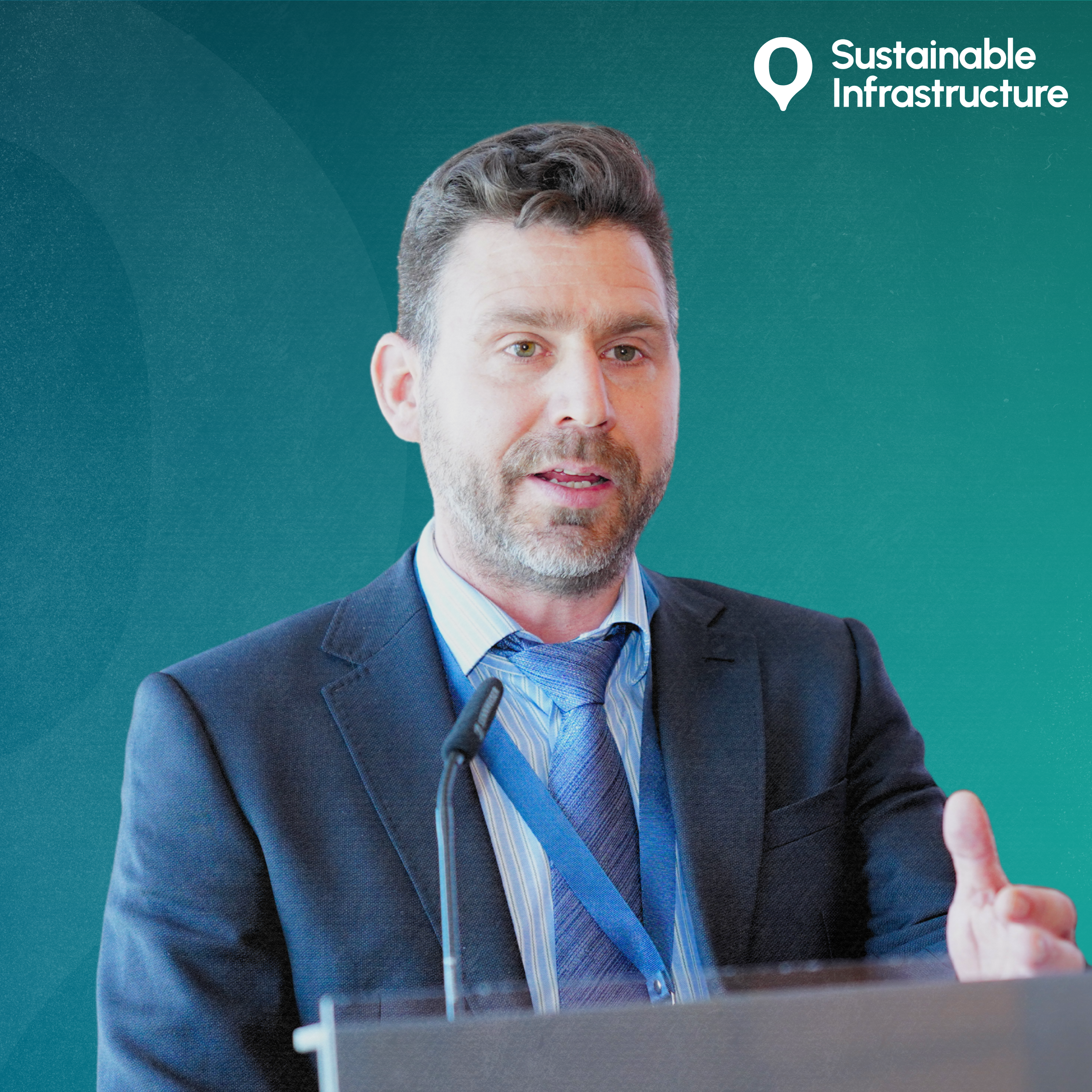
Louis Bettini has spent 15 years as the lead of sustainability at this state government road agency, and also chairs PIARC Technical Committee 4.5 on Decarbonisation of Road Construction and Maintenance. He came to infrastructure sustainability from a commerce degree, and before that, from a cattle station in the Pilbara, where the nearest town was 60 kilometres away, and resourcefulness was simply how you lived. That combination of business pragmatism, lived environmental experience, and now international standards work gives him a perspective that is quite rare.
This episode covers three interconnected topics: what genuine climate adaptation looks like for a road network that cannot be designed for every weather event, how Western Australia is approaching decarbonisation by linking it to public funding from the biggest projects down, and what it actually takes to move people inside a large organisation who would rather not be moved.
Louis is not waiting for perfect data or perfect conditions: he has built a data-driven vulnerability assessment tool, launched a circular economy plan targeting six priority materials, and is working through the human relationships that make any of it stick. The first step, he says at the end, is the hardest. After that, you find out where it leads.
Climate Adaptation in a Landscape That Is Already Changing
Louis does not speak about climate change in the abstract. His family's property sits on a river delta system in the Kimberley, a million-acre landscape where the river changed course entirely following two record-level floods in the last 20 years. The most recent cyclone cut a new channel out towards the coast. The landscape, in his words, is permanently different.
In his operational work at Main Roads, Louis describes a team that was very capable of looking backwards at historical weather events but not yet oriented towards future scenarios. The vocabulary of resilience planning - sensitivity, exposure, adaptive capacity - was not yet part of how asset managers framed their decisions. His work was partly about translating that language and partly about building the data infrastructure to make vulnerability assessment quantitative rather than stakeholder-driven.
"We want to move away from stakeholder-driven datasets, because depending on how you use them, you can potentially change the numbers to get the answer you want. We want the data to be showing you where you should prioritise."
The tool they are building scores road network assets against multiple vulnerability components and uses publicly available data as its primary input. The goal is a first-pass assessment that tells you where to invest, independent of local advocacy. For a road network serving remote communities with no alternative routes, getting that prioritisation right is about which communities retain connectivity when a weather event hits.
Louis makes one point that cuts against the grain of most resilience conversations: as a world, he argues, we should be putting more energy into decarbonisation than adaptation. The costs we can avoid by decarbonising aggressively outweigh the costs of building resilience into existing infrastructure. Adaptation is necessary but insufficient. It is what you do while doing the harder thing.
Decarbonisation Through Funding: Linking Requirements to the Biggest Projects
Western Australia has a substantial pipeline of road infrastructure construction, and Louis describes a policy logic that begins with funding. Link decarbonisation requirements to the funding of major projects, and the behaviour change flows through tiers of subcontractors and eventually through to material suppliers. While the mechanism is simple, the difficulty lies in clearly defining the requirements so that the industry can plan against them.
Main Roads has a net-zero transition plan focused on its own operational emissions, but Louis points out that the harder work is the industry decarbonisation plan: getting the full contractor base across all tiers moving in the same direction. The idea is to use large public contracts as a signalling mechanism: if we require it for our biggest projects, industry builds the capability to deliver it.
Circularity runs through this as the practical lever for embodied carbon. Main Roads has identified six priority materials: crushed recycled concrete for full-depth asphalt, recycled asphalt, crumb rubber in asphalt binder and resealing programmes, green steel, low-carbon concrete, and recycled plastic. Each of these reduces dependence on virgin materials, cuts waste to landfill, and has the secondary benefit of stimulating local supply chains.
"You have to put the intent out there to get the outcome you want. Green steel: we're dependent on local private industries developing, because we don't have many local industries for steel right now. But if we don't signal the demand, the supply won't come."
The circularity agenda in Australia was partly accelerated by the ban on waste exports to China, which forced domestic recycling infrastructure to develop or fail. That context made the business case for recycled materials more legible to procurement teams. Louis sees it now as genuinely integrated into decarbonisation planning.
What Louis Learned from France, and What He's Applying at Home
When asked which international approach to decarbonisation inspires him most, Louis is specific: France, not because of the scale of ambition, but because of the chain that connects ambition to action. France has built tools that industry actually uses, tied those tools to contracts, and tracked performance against them. That chain: tool, contract, measurement, improvement, is precisely what Louis is trying to build in Western Australia.
PIARC TC 4.5 is the international vehicle for this kind of cross-pollination: you get out what you put in, you learn more than you share, and the standardisation work is genuinely valuable even when it is slow. The committee is currently preparing two deliverables for its Highways UK showcase in Birmingham in November: one on planning and design for decarbonisation, and one on decarbonisation of road construction and maintenance from the project perspective.
The goal of standardisation matters because, without it, every jurisdiction starts from scratch. Countries that have not yet built up resilience or decarbonisation capability can learn what does and does not work without paying the hard way. That is the theory of PIARC. In practice, Louis acknowledges that data-driven approaches require resources that not every road agency has. Scenario planning is a more accessible starting point. The current resource constraints should not limit the aspiration.
The Human Problem: Moving People Who Do Not Want to Move
Technical frameworks only work if someone within the organisation carries them. Louis is direct about this: sustainability practitioners are usually resource-constrained, which means they cannot work on everything at once. Sometimes you have to be honest that a particular stakeholder or team is not worth your time right now. Go where you can make progress. Demonstrate that it works. Then come back.
"You need to leverage relationships for anything that comes with sustainability. That's at a personal practitioner level all the way through to an organisation."
When you do need to bring a sceptical asset manager along, Louis describes two techniques. First, respond to their worldview and frame of reference, not yours. Second, do not try to do it alone: build allies who can reinforce the message at the peer level, not just from the sustainability function. The sustainability practitioner, as a lone advocate, rarely succeeds. The sustainability practitioner as coordinator of a broader coalition has a better chance.
There is a useful asymmetry here specifically for public road authorities. Louis makes the point that, as a public authority, Main Roads has more direct procurement levers than an engineering firm that must respond to a client's requirements. You are the client. You define what the spec asks for. That creates a form of accountability that also provides the genuine power to drive change across the entire construction supply chain.
What Comes Next
Louis sees the next critical step as giving the industry a clear forward trajectory.
Without a credible signal about where the road agency wants to be in five or ten years, contractors cannot make the capital investments that decarbonisation requires. You can buy small electric vehicles as a first step, but the large-equipment transitions (haul trucks, pavers, heavy plant) require the industry to invest years in advance. They will only do that if they believe the demand is real and sustained.
The implication for road agencies is that internal target-setting and public commitment serve an industrial policy function, not just a reporting function. When you say you will require X by 2030, you are telling the equipment manufacturers and material suppliers to start now. That is different from announcing a target for its own sake.
Louis is modest about where this ends up. He does not predict specific technologies or timelines. He focuses on the mindset that accompanies the technical change: understanding where you want to be, being honest about where you are, and not letting resource constraints determine your aspirations.
Full interview
The following is an edited transcript of the conversation.
From the Pilbara to Policy: How Louis Got Here
Renaud: Louis, welcome. We've met through PIARC, in the work around resilience and decarbonisation. Can you introduce yourself and what you're doing?
Louis: I'm the lead of sustainability at the state government road agency in Western Australia. I've been looking after corporate sustainability within that organisation for about 15 years: sustainability policy, capability uplift, and also chairing Technical Committee 4.5 on decarbonisation of road construction and maintenance at PIARC. I've got a lot to share from the last 10 years in particular.
Renaud: How did you get into sustainability? Was it training, or did you come from another discipline?
Louis: Two main areas. I grew up on a remote cattle station in Western Australia, in the Pilbara region, more commonly known for its mining industry. The closest town was 60 kilometres away. You soon learn to be resourceful and not to waste anything. My upbringing was always reusing things, collecting different parts from different pieces of machinery. Sustainability and resource efficiency were part of my childhood before I had a word for them.
Then I went through university - I'm actually a commerce graduate - and through my studies I got interested in sustainability at the time. The world was just unpacking the word. In Western Australia it was still relatively new. That really got me interested in what sustainability meant for business, for organisations, and how they had to change. I saw a real opportunity to make an impact.
Renaud: Commerce to sustainability: not the standard path, but having that business perspective is important. And given your background in a remote environment, the question of resilience and climate impact must feel very personal.
Louis: Yes. I still get to go back to my family's properties and see firsthand the impact of climate change. We're not on the same property I grew up on as a child, but it's a coastal environment and we're impacted by severe storms. They're quite frequent. We've definitely been experiencing very significant impacts to the landscape.
The property sits on a river delta system. In the last 20 years we've had two of the highest floods on record run straight through the property. We're talking a million acres, so it's not small. And the river has changed its pathway over those 20 years. About two or three years ago, from the last cyclone, it cut a completely new channel out towards the coast. It's going to completely change that landscape. I've noticed anecdotally the impacts of severe weather events and our changing climate.
Road Network Resilience: Data, Not Advocacy
Renaud: That's a striking impact. And it feeds directly into your work. How do you translate the need to act into your daily activities on climate adaptation?
Louis: I work alongside teams. I don't claim to be an asset manager or a climate scientist. I try to bring knowledge and fill gaps I can see within the organisation. With that, we've embarked on a number of projects.
Understanding the vulnerability of our network to climate change going forward was one of the first pieces of work I facilitated. What we had was: our teams were very good at looking historically at what was occurring, but not necessarily projecting into the future. And they didn't necessarily have the language around resilience to help frame the decisions they were making.
Western Australia is a very big place, almost bigger than Texas. You have three different climate types and a sparsely populated, remotely connected network. When you're looking after a road network like that, you have to think about the level of service for the communities you're serving. We were impacted by a cyclone in the Kimberley and one of our bridges was completely destroyed. We had to adapt fast: we moved work teams off one contract onto another to replace that bridge quickly. What works in one context doesn't necessarily work in every context. You can't design a road network to be resilient for all weather events and all climate changes. So I work with our teams to place their thinking into a framework of resilience: being prepared, planning, responding, recovery, so they can understand where they actually sit.
Renaud: You're pointing at two dimensions: how do I respond to events, and how do I anticipate and plan for future conditions? And specifically, on vulnerability assessment, what are the weighting components that matter most?
Louis: From my perspective, it's about bringing the right information to the practitioners who need it. They want to understand technically what is going on. We've embarked on a research project that looks at the different components of vulnerability: sensitivity, exposure, adaptive capacity, and criticality, and scoring and weighting each of those. And we're trying to make it a data-driven process, picking up existing data or data that's publicly available.
We want to move away from stakeholder-driven datasets because, depending on how you use them, you can potentially change the numbers to get the answer you want. We want the tool we're building to function as a first-pass vulnerability assessment, and also to help us determine where we should prioritise investment for network upgrades. If you're using it for investment decisions, you don't want stakeholders saying "it's really vulnerable here, so we should do something there." You want the data to be showing you where you should prioritise.
Renaud: And transferring this to other countries through PIARC, how do you see that playing out globally? Is the world taking this seriously enough?
Louis: Look, I think as a world we should be focusing on decarbonisation rather than adaptation. That's where we need to be putting most of our energy right now. Even though we're experiencing the impacts of change already, there are a lot of costs we can avoid if we put our energy into decarbonisation rather than resilience.
In terms of countries picking up resilience and climate adaptation, I think it's definitely a cultural aspect. Australia is a natural hazard-exposed country. We experience bushfires and flooding as part of course within our lives, so we're a bit more prepared for it. Some communities and countries may not be as exposed, so it's not in their conversation.
For adopting our data-driven approach, I wouldn't say it's for everyone. There are a lot of resources and data you need to do it. Scenario planning techniques might be more affordable for some road agencies. Your current resourcing shouldn't determine what you aim to be doing as an organisation.
Decarbonisation: Starting with the Biggest Contracts
Renaud: So your focus today — and your recommendation — is to put real effort into decarbonisation. What's your approach in Western Australia?
Louis: The major thing I see coming through in terms of government policy is linking decarbonisation with funding. Start with major projects and the biggest contractors, and weave that through industry. If you can change the biggest contracts with the biggest carbon impact, you get better decarbonisation benefits across your whole economy.
We have a large road infrastructure pipeline in Australia in terms of new construction and development, so that pushes policy makers in this direction. Main Roads has a net zero transition plan — inward-looking, focused on what's directly related to our activities. But we also want an industry decarbonisation plan that covers our entire construction industry, all tiers of contractors, building on the work already happening in major projects.
We also want to tie that into our electric vehicle strategy, then rolling that out more broadly.
Renaud: Are there financial levers to incentivise reduction, or is it more compliance-driven?
Louis: For our organisation, it's partly funding requirements. We're required to report on how we implement decarbonisation in major projects, and guidance has been developed to support that. But there's also funding available for industry, for heavy vehicles, for approaches to heavy equipment, to help the intent of government and the will of industry meet. Different levels of incentives, and also reporting requirements.
Renaud: And your involvement in PIARC TC 4.5. What's your personal motivation there?
Louis: It's always push and pull. Learning, because you don't know what you don't know, but also sharing different experiences. PIARC is a community where what you put in is what you get out. And I genuinely believe I learn more than I pass on when it comes to big international committees.
For the committee itself, the role is standardisation: what projects are being undertaken for decarbonisation within road infrastructure, and helping with capability uplift. Lots of jurisdictions and industries have already been through this. There are things you should do, things you shouldn't do. That's something we can pass on and help countries make their decarbonisation ambitions successful.
Renaud: Do you have examples that inspire you, that you're directly applying?
Louis: I think the French approach to decarbonisation, having a roadmap, having strategies that link through to practical action, is definitely an inspiration. I'm directly applying that within my jurisdiction through our net-zero transition plan and our circular economy plan.
The French approach of developing tools that are used by industry, then linking those to projects and contracts, is needed: you can't have good performance without measurement, and ongoing measurement. And looking at the hard-to-reach areas - embodied carbon in materials - because there are so many players and so many commercial and technical constraints. Getting impact in the materials space is genuinely inspiring.
Circularity: Six Priority Materials and the Local Supply Chain
Renaud: And circularity, is that a big issue for you locally?
Louis: Definitely. In Australia, we were previously exporting waste to China for processing. When that ban came in, it automatically became a huge issue for our jurisdiction. Fast forward five years, and it continues to be relevant because we're linking it through our decarbonisation aspirations.
We've identified six priority materials: crushed recycled concrete for use under full-depth asphalt; recycled asphalt; crumb rubber within asphalt binder and our resealing programme; green steel; low-carbon concrete; and recycled plastic. All of those are tied to decarbonisation, reducing transport miles, and reducing waste to landfill. We also want to stimulate local economies and local supply for those materials, which is a challenge for some of them.
Green steel, we're dependent on local private industries developing capability, because we don't have many local steel industries right now. But you have to put the intent out there to get the outcome you want.
The Human Side: Relationships, Allies, and Honest Prioritisation
Renaud: As a public road authority, you have strong procurement levers. What advice would you give to others across the ecosystem — engineering firms, agencies — on how they can act today?
Louis: The thing for me is: you need to leverage relationships for anything that comes with sustainability. That's at a personal practitioner level all the way through to an organisation. As an organisation, we know we have to work with the contract industry and the design industry to make any of our ambitions happen. But as a practitioner, I need to be working and collaborating with asset managers and technical leaders — taking them on the journey.
It's not just the technical. The relationship is the big thing for sustainability practitioners.
Renaud: And what about the sceptics? The asset managers who aren't engaged?
Louis: There are a couple of techniques. First: be honest with yourself. When you're resource-constrained — which sustainability practitioners often are — it may not be worth your time to work with the blockers. Find the areas where you can make improvement and go with that. Then there are times when you have a deadline and you need to bring someone along.
For that second situation: respond to that person's worldview, their frame of reference. And surround them with peers who can help you on the journey. It's not just you working with them — you need allies working with them as well. Be honest with yourself about which of these two situations you're in.
The Next Big Step: Giving Industry a Trajectory
Renaud: Looking forward, what do you see as the next strong lever, in four or five years?
Louis: The next big step is road agencies taking control of where they want to get to with industry: thinking through the trajectory, not just the target. Without that forward trajectory, without giving industry the ability to plan, we won't get far. Some things industry will act on without being told: they know they need to decarbonise, and they can start with small electric vehicles. But there are big-ticket items - heavy plant, haul trucks - that require long-term capital investment. Industry will only make those investments if they believe the demand signal is real and sustained.
We also need to support a mindset shift alongside all the technical and industrial innovation. Understanding where we need to be is the foundation.
Renaud: There's a TC 4.5 meeting at Highways UK in Birmingham in November. Any invitation for listeners?
Louis: Yes, I'd definitely extend the invitation to collaborate. TC 4.5 plans to do a joint session with Technical Committee 3.5, which looks at the decarbonisation of road networks. We're planning at least one or two workshop activities. Please come along, please get engaged. Part of making PIARC's products right for the industry is understanding how they're viewed externally. We'll be showcasing two deliverables: one on planning and design for decarbonisation, one on decarbonisation of road construction and maintenance from the project perspective. We need more eyes and opinions on that work.
Renaud: Final word, a piece of advice?
Louis: Take the first step. These big things can be daunting, decarbonisation certainly is, depending on where you sit in your organisation. But take that first step. Reach out. You don't know what response you'll get. Just do it a little bit. Take that first step.
Guest bio
Louis Bettini is Principal Advisor Sustainability at Main Roads Western Australia, where he has led the agency's corporate sustainability programme for 15 years. He chairs PIARC Technical Committee 4.5 on Decarbonisation of Road Construction and Maintenance.
About Main Roads Western Australia
Main Roads Western Australia is the state government agency responsible for planning, construction, maintenance, and operation of the state's primary road network, one of the most geographically extensive and climatically diverse road networks in the world. The agency operates across three distinct climate zones, serves remote communities with no alternative connectivity, and manages a major infrastructure construction pipeline.
Resources & Links Mentioned
- PIARC Technical Committee 4.5 — Decarbonisation of Road Construction and Maintenance
- Highways UK 2025, Birmingham