


Hello, infrastructure leaders and operators,
There's a phrase that stayed with me from our latest podcast episode. Andreas Linnet, Global Decarbonization Lead at Ramboll, described the changes that occur when infrastructure teams start working with actual carbon data rather than estimates. He called it "going from feelings to facts."
Andreas Linnet on why the designer is the most important person in net-zero infrastructure
.png?width=600&height=346&name=Alice%20Header%20(1).png)
Most project teams today are not making bad carbon-related decisions out of malintent, but more from a lack of complete information. Without product-level data across material options, without the ability to compare scenarios at the design stage, the instinct of an experienced engineer becomes the default tool. What Andreas describes at Ramboll is what happens when you systematically close that gap. In this podcast episode, you'll learn:
- Why the designer is the decarbonisation lever
- How quantifying carbon footprint systematically exposes low-hanging fruit that no one saw coming
- Why are requirements the catalyst element
- Why KPIs stuck in time and money are the root cause
- How AI + experience-based databases will reshape the starting point
Other news I wanted to share this week:
Transforming Transportation: structural shifts on infrastructure finance and investments
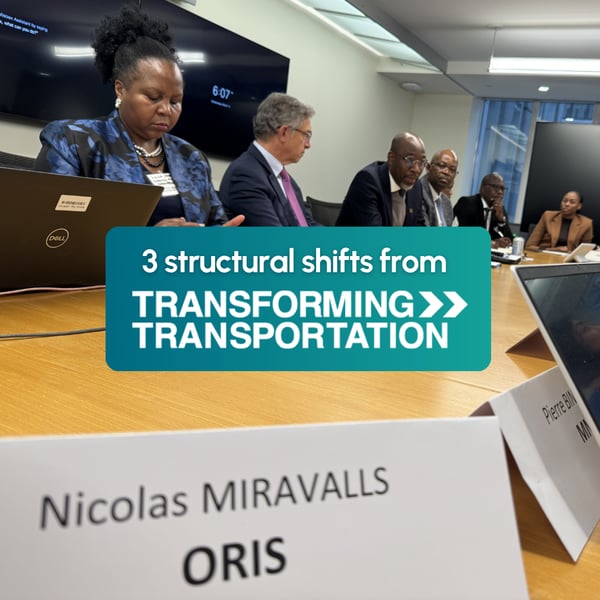
I was in Washington at the beginning of March for sessions and meetings with transport and climate specialists from multilateral banks around the world. Here are the takeaways from this trip:
-
Multi-criteria evaluation becomes institutional
The World Bank's move toward rated criteria in project assessment is more significant than it appears. It makes comprehensive technical evaluation a real expectation instead of historically, good practice. Cost, carbon, circularity, resilience, adaptation... assessed simultaneously, not sequentially.
-
Resilience reframed as investment logic
The most interesting shift in the resilience conversation this year so far is that now it's a $$$ conversation. It's no longer driven by compliance framing. Projects are increasingly being evaluated on their lifecycle exposure, the climate risks they face over 20–30 years, and whether the design accounts for them up front. The argument is (and has always been) economic: better-designed projects fail less, cost less to maintain, and deliver more predictable returns. Indeed, while most are convinced by the climate facts, that's a language development finance understands.
-
Private finance of infrastructure is becoming a reality
The forms are multiplying: blended finance, project bonds, evolving PPP structures. What this does to the traditional MFI lending model is still being worked out. But the direction is clear: more capital sources means more demand for rigorous, comparable, standardised project data.
A deep-dive session on resilience
.png?width=600&height=338&name=OpenBIm%20rectangle%20(14).png)
Following the strong interest of our previous webinar on adaptation measures for infrastructure resilience, we're hosting a deep-dive session on our specific methodology with our resilience expert Danilo that couldn't make it: https://app.livestorm.co/oris/technical-deep-dive-from-climate-data-to-decision-ready-indicators